




What's Happening?
Negotiations for a global plastics treaty, aimed at addressing plastic pollution across its entire life cycle, have stalled. The Intergovernmental Negotiating Committee (INC) met in Geneva from August 5 to 15, 2025, for INC-5.2 but adjourned without reaching
a consensus. The next official round of talks, INC-5.4, is now scheduled to take place between March 13 and 24, 2027, with the venue yet to be announced. This delay follows previous failures to reach an agreement in Busan in December 2024 and Geneva in August 2025. Julio Cordano, Chile’s director for environment, climate change, and oceans, was elected chair of the negotiations on February 7, 2026, replacing Luis Vayas Valdivieso. A core disagreement persists, with approximately 70 countries in the High Ambition Coalition advocating for binding limits on plastic production and bans on toxic plastics, while a smaller group of oil-producing nations prefers a treaty focused primarily on waste management. Informal meetings have been held, and Cordano released an informal 'aid to negotiations' in August 2026, which notably lacks production limits, chemical controls, or finance provisions.
Why It's Important?
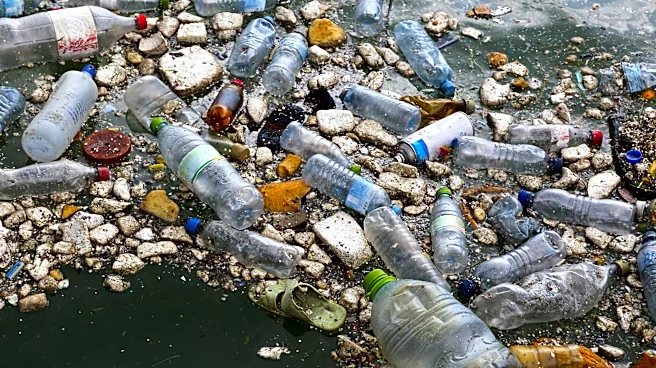
The continued delay in establishing a global plastics treaty has significant implications, particularly for regions like Southeast Asia, which are disproportionately affected by plastic pollution. A 2021 study by Meijer and colleagues estimated that five Southeast Asian countries contribute over half of the river plastic reaching the ocean, with the Philippines alone accounting for approximately 356,000 tonnes annually. Without a unified global framework, these nations continue to bear the environmental and economic costs. The World Bank estimated in March 2021 that Malaysia, the Philippines, and Thailand collectively lose about $6 billion annually due to single-use plastics being discarded instead of recycled. The absence of a treaty means that national Extended Producer Responsibility (EPR) laws, which are being implemented in countries like the Philippines and Vietnam, operate in isolation, failing to address cross-border waste flows and the lack of funding for collection systems in lower-income countries. The current draft's omission of production limits and financial provisions means that plastic production is projected to nearly triple by 2060, exacerbating the problem for regions with weak collection infrastructure.
What's Next?
The next formal session, INC-5.4, is slated for March 13-24, 2027, though the venue remains unconfirmed, suggesting potential for further schedule adjustments. Prior to this, a final round of informal talks is planned for January 2027. The chair, Julio Cordano, has expressed his expectation that the treaty will be adopted at INC-5.4. However, the fundamental disagreement between countries advocating for production limits and those favoring waste management solutions continues to be a major hurdle. For companies and buyers, the absence of a global treaty means navigating a patchwork of national regulations, such as EPR obligations in the Philippines and Vietnam, which carry their own deadlines, payments, and fines. A treaty with design or chemical rules, if eventually adopted, would significantly alter packaging specifications for exporters across the region. The bottleneck in plastic recovery, particularly for low-value plastics, highlights the ongoing need for effective collection programs.
Beyond the Headlines
The prolonged impasse in global plastics treaty negotiations underscores a deeper tension between environmental protection and economic interests, particularly those tied to the petrochemical industry. The debate over whether to focus on reducing plastic production or managing waste reflects differing philosophies on addressing environmental crises. The current situation allows for a continuation of the status quo, where the burden of plastic pollution disproportionately falls on developing nations, often those with less capacity to manage it. The lack of financial provisions in the current draft means that the global community is not yet committed to adequately funding the infrastructure needed for effective plastic waste management in lower-income countries. This raises ethical questions about global responsibility and environmental justice. The ongoing delays also highlight the challenges of achieving consensus on complex global issues when national interests and economic priorities diverge significantly, potentially leading to a fragmented approach to a global problem.