

What's Happening?
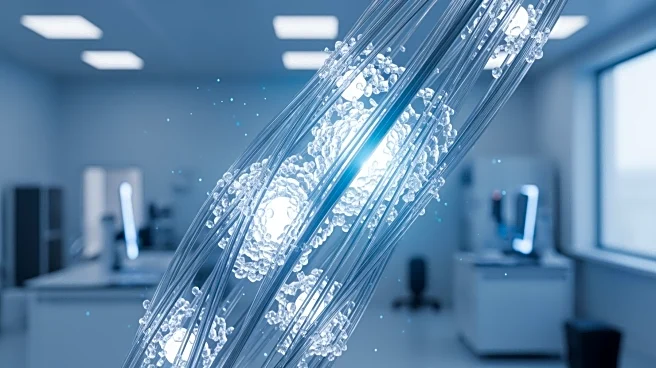
A study led by Martin Rahm and published in ACS Central Science suggests that frozen hydrogen cyanide (HCN) could have been a catalyst for the formation of life's building blocks on Earth. The research indicates that HCN, when frozen, forms needle-like
crystals that generate strong electric fields, facilitating chemical reactions even at low temperatures. These reactions could lead to the formation of amino acids and nucleobases, essential components of life. The study also posits that similar processes might occur in cold extraterrestrial environments, such as on Saturn's moon Titan or in comets, where HCN is prevalent. This discovery challenges previous assumptions about the inert nature of HCN in cold conditions and opens new avenues for understanding prebiotic chemistry.
Why It's Important?
The findings of this study have significant implications for our understanding of the origins of life on Earth and potentially elsewhere in the universe. By demonstrating that HCN can act as a chemical engine in cold environments, the research provides a plausible mechanism for the synthesis of complex organic molecules necessary for life. This could reshape scientific perspectives on how life might arise in different planetary conditions, particularly in environments previously considered too cold for such processes. The study also highlights the potential for discovering life or life-like processes in other parts of the solar system, thereby expanding the scope of astrobiological research.