







What's Happening?
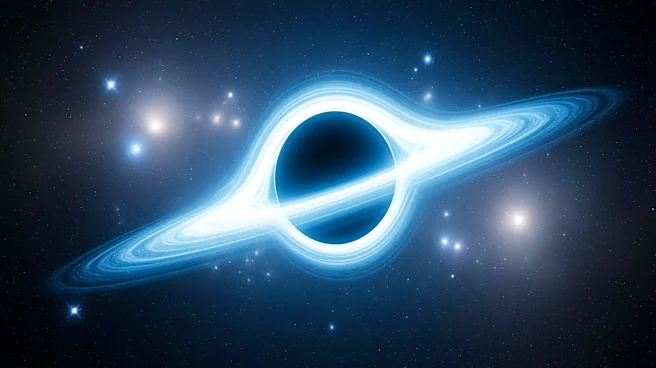
NASA's Chandra X-ray Observatory has discovered a unique 'X-ray dot' that may provide crucial insights into the nature of supermassive black holes. This object, located approximately 11.8 billion light-years from Earth, exhibits characteristics of 'little
red dots' (LRDs) but uniquely emits X-rays. LRDs are thought to be supermassive black holes shrouded in dense gas, which typically prevents X-ray emissions. The discovery suggests that this X-ray dot represents a transitional phase in the evolution of supermassive black holes, potentially bridging the gap between LRDs and typical growing supermassive black holes. This finding could help astronomers understand the formation and growth of these massive cosmic entities.
Why It's Important?
The discovery of the X-ray dot is significant as it may redefine our understanding of supermassive black holes and their development. By identifying a transitional phase, scientists can better comprehend the lifecycle of these black holes, which are pivotal in shaping galaxies. This research could also enhance our knowledge of the early universe, as these black holes are believed to have formed shortly after the Big Bang. The findings may influence future astronomical studies and observations, potentially leading to new insights into the universe's structure and evolution.
What's Next?
Future observations are planned to confirm the nature of the X-ray dot and further explore its characteristics. These studies will aim to determine whether the object is indeed a transitional LRD or a different type of black hole obscured by exotic dust. The collaboration between NASA's Chandra X-ray Observatory and the James Webb Space Telescope will continue to play a crucial role in these investigations, potentially leading to groundbreaking discoveries in the field of astrophysics.