
What's Happening?
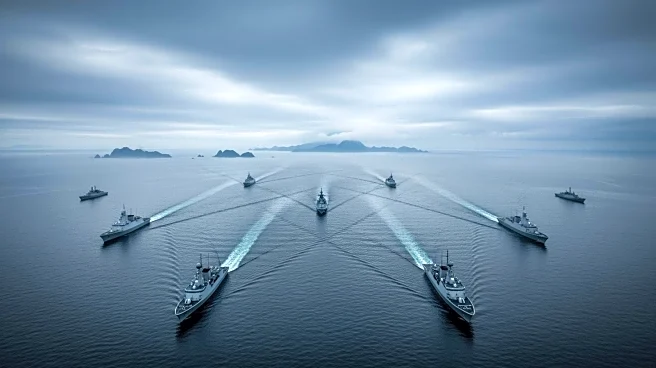
China has initiated military drills around Taiwan, simulating the seizure and blockade of key areas on the island. These exercises, named 'Justice Mission 2025', involve the army, navy, air force, and rocket
force, and include live-fire exercises. The drills are a response to perceived threats, such as the recent U.S. arms sale to Taiwan and Taiwan's increased defense measures. Taiwan's government has criticized these drills, viewing them as a challenge to international norms. The Chinese military's Eastern Theater Command has described the exercises as a 'shield of justice' against separatist forces. The drills are part of China's ongoing strategy to assert its claim over Taiwan, which it views as a breakaway province.
Why It's Important?
The military drills underscore the escalating tensions between China and Taiwan, with significant implications for regional security and international relations. The U.S. and Japan, both allies of Taiwan, are closely monitoring the situation, as any conflict in the Taiwan Strait could disrupt global trade routes and impact international markets. The drills also highlight China's growing military capabilities and its willingness to use force to achieve its geopolitical objectives. For Taiwan, these exercises represent a direct threat to its sovereignty and security, prompting it to bolster its defense systems. The situation could lead to increased military spending and strategic alliances in the region, affecting global defense and economic policies.
What's Next?
The continuation of military drills by China is likely to provoke further responses from Taiwan and its allies, potentially leading to increased military presence in the region. Diplomatic efforts may intensify to de-escalate tensions, but the underlying issues of sovereignty and territorial claims remain unresolved. The international community, particularly the U.S. and Japan, may seek to strengthen their support for Taiwan through diplomatic channels and defense agreements. The situation could also influence future U.S. arms sales and military aid to Taiwan, as well as impact China's relations with other countries involved in the Indo-Pacific region.