





What's Happening?
Scientists at the Center for Astrophysics | Harvard & Smithsonian have developed 'Lumina,' one of the largest and most detailed simulations of the early universe to date. This simulation reconstructs the first 2 billion years of the universe's evolution,
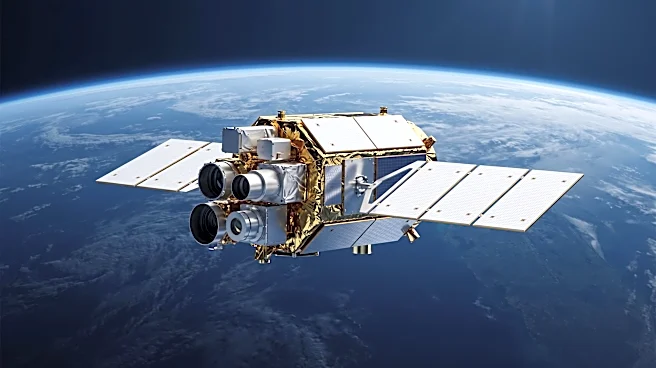
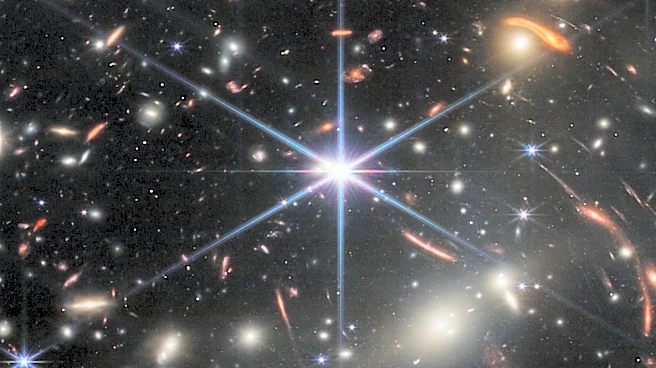
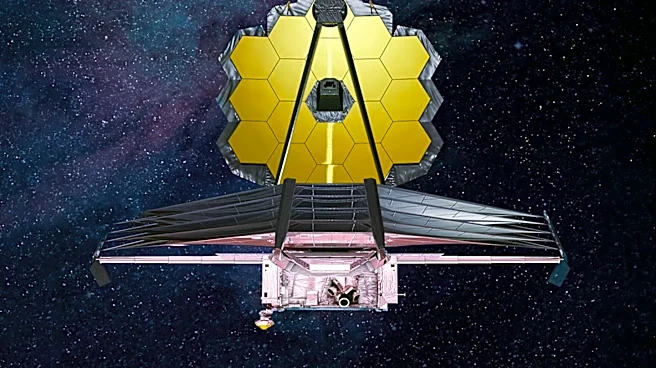
modeling the intricate interactions between ordinary matter, dark matter, and radiation. Lumina aims to help astronomers interpret observations from powerful instruments like the James Webb Space Telescope (JWST) and the Nancy Roman Space Telescope. The research, published in Monthly Notices of the Royal Astronomical Society, allows scientists to evaluate existing theories of cosmic evolution by comparing Lumina's predictions with actual telescope observations. The simulation covers a volume of space approximately 1.5 billion light-years on each side, making it over 100 times larger than previous comparable projects. A significant advancement in Lumina is its treatment of helium reionization, a process where radiation strips electrons from helium atoms. For the first time, this simulation tracks this transformation while simultaneously accounting for its effects on the surrounding universe, enabling the study of the relationship between evolving galaxies, radiation, and the intergalactic gas. The creation of Lumina required immense computational power, utilizing over 15,000 graphics processing units on Frontier, one of the world's fastest supercomputers at Oak Ridge National Laboratory in Tennessee.
Why It's Important?
Lumina represents a significant leap in astrophysical research, providing a powerful tool to bridge theoretical models with observational data from cutting-edge telescopes. By simulating the universe's early stages with unprecedented detail and scale, scientists can test and refine their understanding of how the cosmos evolved after the Big Bang. This is crucial for interpreting the complex data gathered by JWST and the upcoming Nancy Roman Space Telescope, which are peering back into the early universe. The ability to compare simulated outcomes with real observations allows researchers to validate current theories or identify discrepancies that could point to new physical processes or unknown aspects of cosmic evolution. The detailed modeling of helium reionization, in particular, offers new insights into how the early universe became transparent to light and how galaxies influenced their environments. This simulation is vital for advancing our knowledge of fundamental cosmological questions, such as the formation of the first stars and galaxies, the role of dark matter, and the overall structure of the universe.
What's Next?
Researchers plan to use Lumina to explore various aspects of cosmic evolution, including the movement of gas between galaxies, the influence of radiation from the Big Bang, and the emergence of regions with high star formation rates. By juxtaposing these predictions with observations from the James Webb Space Telescope, the Nancy Roman Space Telescope, and other instruments, scientists aim to construct a more comprehensive picture of the universe's earliest chapters. Any unexpected differences between the simulated cosmos and the real one will provide valuable clues, potentially indicating areas where current theories need refinement or reconsideration. This iterative process of simulation and observation will continue to drive advancements in cosmology, leading to a deeper understanding of the universe's fundamental laws and its origins. The ongoing development and application of such powerful simulations will be instrumental in shaping future astrophysical research agendas.
Beyond the Headlines
The development of Lumina touches upon profound philosophical and ethical considerations regarding humanity's quest to understand its origins. By recreating the universe's first 2 billion years, scientists are not just performing a technical feat but are also engaging in a form of cosmic archaeology, attempting to reconstruct the very beginning of everything. This endeavor highlights the power of human intellect and technological advancement to unravel the most complex mysteries of existence. Ethically, the use of supercomputers like Frontier for such simulations raises questions about resource allocation and the balance between fundamental research and more immediate societal needs. Culturally, these simulations contribute to a broader narrative of scientific progress, inspiring awe and wonder about the universe. They also underscore the collaborative nature of modern science, involving researchers from multiple institutions and leveraging advanced computing infrastructure. The potential for Lumina to challenge existing theories could lead to paradigm shifts in cosmology, fundamentally altering our understanding of the universe and our place within it, much like previous scientific revolutions.