





What's Happening?
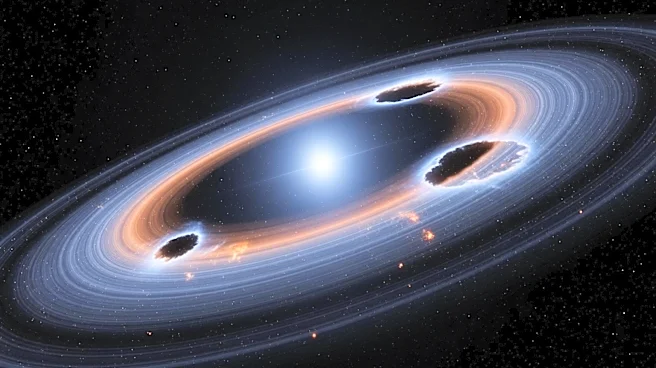
NASA's Hubble Space Telescope has captured unprecedented images of a massive planet-forming disk around a young star, located nearly 1,000 light-years away. Known as IRAS 23077+6707, or 'Dracula's Chivito,' this colossal structure spans approximately
400 billion miles, making it one of the largest protoplanetary disks ever observed. The disk's chaotic environment, filled with towering streams of gas and dust, challenges existing theories about planetary system evolution. The images reveal a highly asymmetric structure, with filament-like features erupting unevenly, suggesting a more dynamic and turbulent process of planet formation than previously thought.
Why It's Important?
This discovery provides new insights into the early stages of planetary development, suggesting that planet formation may involve more violent and chaotic processes than earlier models indicated. The findings could reshape our understanding of how planetary systems, including our own, evolve over time. The ability to observe such detailed structures in a protoplanetary disk offers astronomers a unique opportunity to study the conditions under which planets form. This could lead to a better understanding of the diversity of planetary systems in the universe and the factors that influence their formation.
Beyond the Headlines
The unusual asymmetry observed in the disk raises questions about the forces shaping these environments. The presence of giant filaments on one side of the disk suggests possible external disturbances or internal instabilities. Understanding these asymmetries could provide clues about the interactions between young stars and their surrounding material. The discovery also highlights the capabilities of the Hubble and James Webb Space Telescopes in advancing our knowledge of cosmic phenomena. As researchers continue to analyze these observations, they may uncover new mechanisms of planet formation, potentially leading to revisions in current astrophysical models.