

What's Happening?
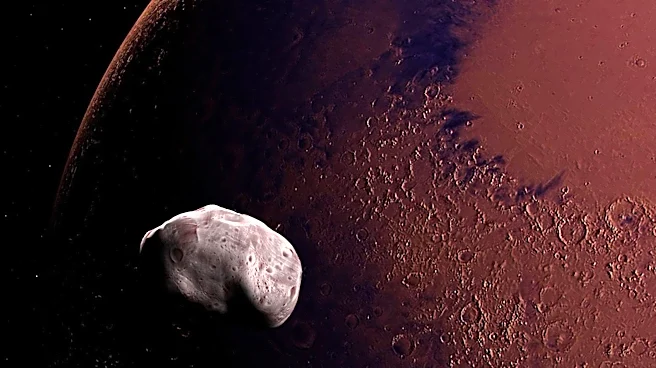
Phobos, Mars' small inner moon, may hold key insights into its origin and the history of Mars. Scientists are exploring whether Phobos was captured as an asteroid or formed from debris after a massive impact on Mars. The moon's interior, particularly
around Stickney Crater, could provide answers. If Phobos formed from a giant impact, the Stickney event may have occurred 4.2 billion years ago. Alternatively, if Phobos is a captured asteroid, the impact may be much younger. Recent studies suggest Phobos has a porous interior, possibly containing water ice, and detailed mapping of its gravitational field could test these theories.
Why It's Important?
Understanding Phobos' origin is crucial for planetary science as it could provide insights into the history of Mars and its moons. The moon's unique characteristics, such as its irregular shape and proximity to Mars, make it a valuable subject for studying planetary formation and evolution. The upcoming Japanese Martian Moons Exploration (MMX) mission aims to collect samples from Phobos, which could offer direct evidence of its composition and formation history. This research could also inform future missions and the search for life on Mars by revealing the planet's geological and impact history.
What's Next?
The MMX mission, set to launch in late 2026, will attempt to collect samples from Phobos and return them to Earth by 2031. This mission will provide a unique opportunity to study Phobos' composition and test theories about its origin. The mission's success could pave the way for further exploration of Mars' moons and enhance our understanding of the solar system's history. As scientists continue to analyze Phobos' gravitational field and interior structure, new discoveries may emerge, offering deeper insights into the processes that shaped Mars and its moons.