









What's Happening?
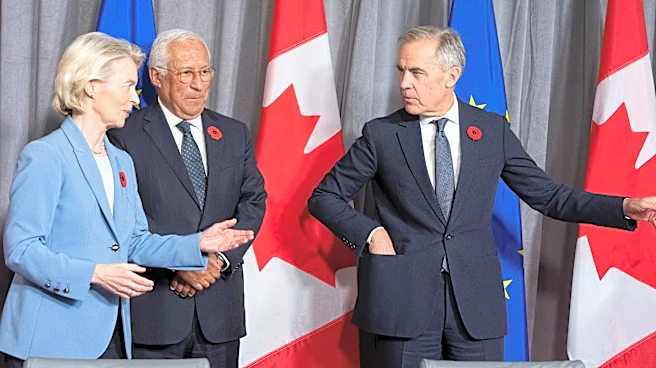
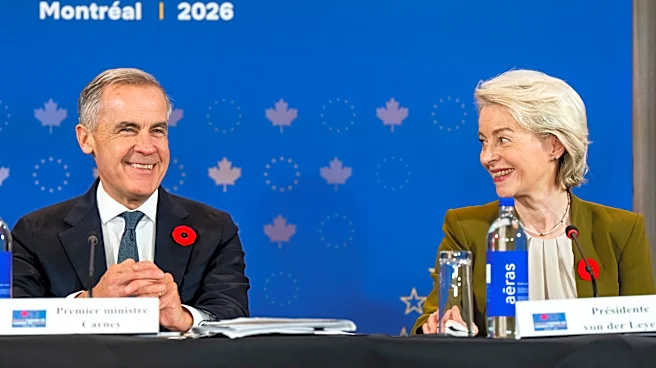
Canada and the European Union have concluded a summit in Montreal, establishing an 'alliance for the future' pact with various agreements set to affect multiple sectors. European Commission President Ursula von der Leyen expressed the EU's desire for Canada to fully
join Erasmus+, the EU's student exchange program, and for Canada to become a full member of the Horizon Europe research partnership program by 2028. The pact also includes a digital trade agreement, efforts to integrate Canada into the EU's instant payment systems, and exploration of opening financial markets. Additionally, the European Investment Bank will seek to fund critical raw material mining projects in Canada, and Canada has committed 500 million euros (approximately C$775 million) to an EU loan program for Ukraine.
Why It's Important?
This comprehensive pact between Canada and the European Union holds significant implications for the United States, particularly in areas of trade, technology, and international relations. Increased cooperation between Canada and the EU could reshape global supply chains and trade dynamics, potentially affecting U.S. economic interests. The digital trade agreement and efforts to integrate payment systems could set new standards for international digital commerce, which the U.S. may need to consider in its own trade policies. Furthermore, Canada's commitment to funding critical raw material mining projects with European investment could impact global resource markets, potentially influencing U.S. access and pricing for these materials. The joint support for Ukraine also highlights a united front against Russian aggression, which aligns with U.S. foreign policy objectives but also demonstrates a growing independent European and Canadian role in global security.
What's Next?
Many of the agreements within the Canada-EU pact will require months or years to finalize and implement. Canada's full integration into Erasmus+ and Horizon Europe will open new avenues for academic and research collaboration, potentially attracting U.S. students and researchers to these programs or prompting similar U.S. initiatives. The digital trade and financial market integration efforts will necessitate regulatory alignment and could lead to new cross-border business opportunities. The funding for critical raw material mining in Canada will likely see increased investment and development in the coming years. Canada's financial contribution to Ukraine through the EU loan program signifies ongoing support for the war-torn nation, with potential for further coordinated international efforts. The pact also establishes formal discussion groups on various topics, including the Arctic and misinformation, indicating a long-term commitment to addressing shared global challenges.
Beyond the Headlines
The 'alliance for the future' pact extends beyond immediate economic and political benefits, signaling a deeper alignment of values and strategic interests between Canada and the European Union. This strengthened partnership could serve as a counterweight to other global powers and influence multilateral institutions. The focus on student and research exchange programs underscores a commitment to fostering intellectual and cultural ties, which can have long-term societal impacts. The joint efforts to combat misinformation and address climate security highlight a shared vision for a more stable and sustainable global order. However, the success of this alliance will depend on navigating complex geopolitical shifts, including the evolving relationship with the United States and other major economies. The pact represents a strategic move by Canada and the EU to enhance their collective influence and resilience in an increasingly interconnected world.