



What's Happening?
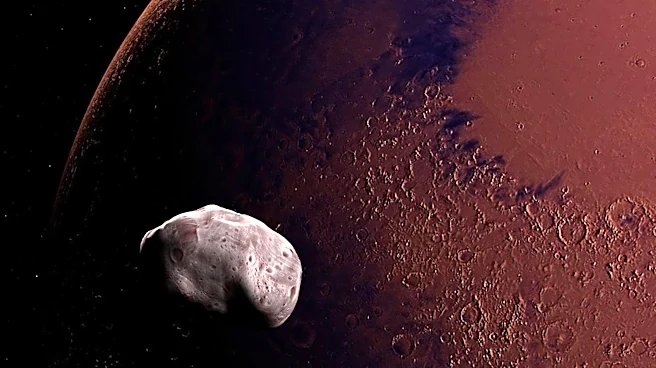
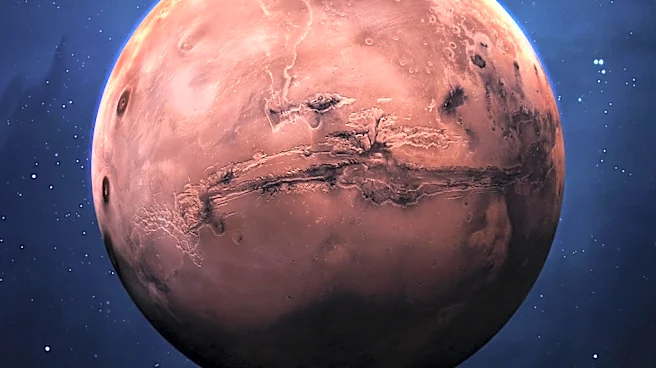
The ESCAPADE (Escape and Plasma Acceleration and Dynamics Explorers) mission, led by the University of California, Berkeley, is equipped with Visible and Infrared Observation System cameras to detect visible Martian auroras and analyze the thermal properties
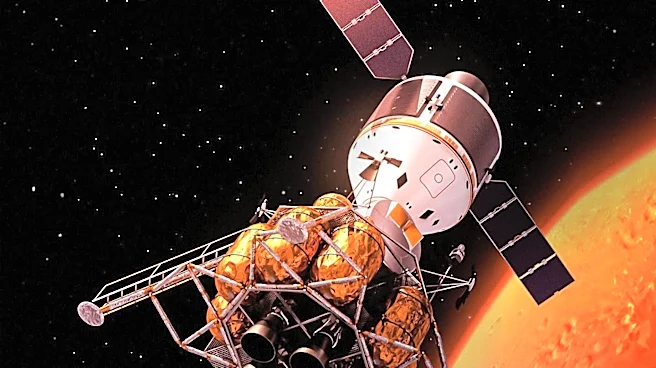
of Mars' surface and atmosphere. These cameras, provided by Northern Arizona University, recently captured images of Earth and the Moon from a distance of 363,250 miles and 115,600 miles, respectively. These images, taken on July 3, serve as a calibration check for the mission's instruments. The spacecraft are currently in a 'loiter' orbit around Lagrange point 2 and are scheduled to use Earth's gravity in November 2026 to slingshot towards Mars, arriving in September 2027. The mission aims to study the interaction between solar wind and the Martian environment, specifically how it contributes to atmospheric loss on the Red Planet. The ESCAPADE mission is funded by NASA’s Heliophysics Division and is part of the NASA Small Innovative Missions for Planetary Exploration program, involving partners such as Rocket Lab, NASA’s Goddard Space Flight Center, Embry-Riddle Aeronautical University, Advanced Space, and Blue Origin.
Why It's Important?
This mission is crucial for advancing our understanding of planetary atmospheres and space weather. By searching for visible Martian auroras and investigating thermal properties, ESCAPADE will provide valuable data on how Mars' atmosphere interacts with the solar wind. This interaction is a key factor in the planet's atmospheric loss, which has significant implications for understanding Mars' past habitability and its potential for future human exploration. The data collected will help scientists better comprehend the processes that have stripped Mars of its once-thicker atmosphere, offering insights into planetary evolution. Furthermore, the calibration images of Earth and the Moon demonstrate the capabilities of the Visible and Infrared Observation System cameras, ensuring the reliability of future Martian observations. The collaboration between UC Berkeley, NASA, and private companies like Rocket Lab and Blue Origin highlights a growing trend in space exploration, combining academic research with commercial innovation to achieve ambitious scientific goals.
What's Next?
The ESCAPADE spacecraft will remain in their 'loiter' orbit around Lagrange point 2 until November 2026, when they will perform a gravity assist maneuver using Earth to propel them towards Mars. Their arrival at Mars is anticipated in September 2027. Upon reaching Mars, the mission will commence its primary scientific objective: studying the interaction of solar wind with the Martian environment and its role in atmospheric loss. The data gathered from the Visible and Infrared Observation System cameras will be analyzed to identify visible Martian auroras and to map the thermal characteristics of the Martian surface and atmosphere. The findings are expected to contribute significantly to the scientific community's understanding of Mars' atmospheric evolution and the broader implications for planetary science. Further announcements regarding data collection and scientific discoveries are expected following the spacecraft's arrival at Mars.
Beyond the Headlines
The ESCAPADE mission's focus on Martian auroras and atmospheric thermal properties delves into fundamental questions about planetary habitability and the long-term effects of solar activity on celestial bodies. Understanding how Mars lost its atmosphere can provide critical context for assessing the potential for life on other planets and exoplanets. The mission's use of advanced imaging technology to detect subtle atmospheric phenomena underscores the continuous innovation in space instrumentation. Moreover, the involvement of multiple academic institutions and private sector partners in a NASA-funded mission exemplifies a shifting paradigm in space exploration, where diverse expertise and resources are pooled to tackle complex scientific challenges. This collaborative model could accelerate future discoveries and make space missions more efficient and cost-effective, ultimately benefiting the broader scientific community and public understanding of the cosmos.