



What's Happening?
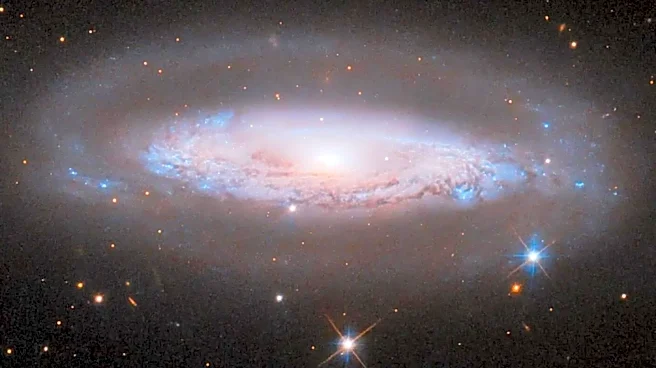
The Hubble Space Telescope and the James Webb Space Telescope (JWST) have combined their observations to create a new composite image of the 'Black Eye Galaxy,' also known as Messier 64. This spiral galaxy, located 17 million light-years from Earth in the constellation
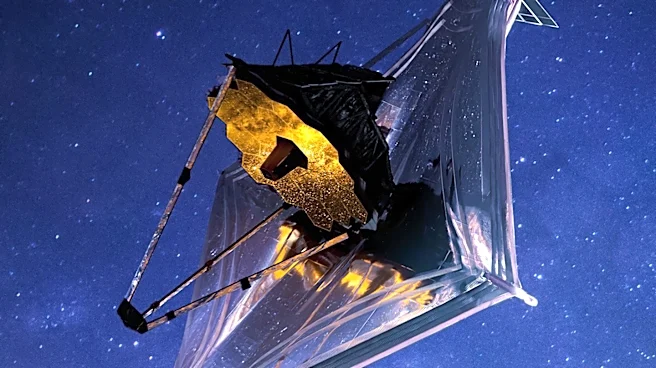
Coma Berenices, is notable for its distinctive appearance and unusual internal motion. Discovered in 1779, the Black Eye Galaxy is characterized by gas in its outer regions rotating in the opposite direction to the gas and stars closer to its center, creating a unique 'hypnotizing stare.' The composite image was created by integrating near and mid-infrared wavelength observations from JWST with ultraviolet, visible, and near-infrared observations from Hubble, showcasing the complementary capabilities of these powerful space telescopes.
Why It's Important?
This collaborative effort between the Hubble and James Webb Space Telescopes is significant because it demonstrates how different advanced instruments can work together to provide a more comprehensive understanding of cosmic phenomena. Rather than replacing each other, these telescopes offer distinct capabilities—Hubble excels in visible and ultraviolet light, while JWST specializes in infrared—allowing astronomers to gather a broader spectrum of data. This multi-wavelength approach reveals details that would be invisible to a single telescope, offering deeper insights into the structure, composition, and dynamics of galaxies like the Black Eye Galaxy. The success of this collaboration sets a precedent for future astronomical research, highlighting the value of combining data from various observatories to push the boundaries of scientific discovery and enhance our understanding of the universe.
What's Next?
The successful collaboration between Hubble and JWST is likely to inspire more joint observation campaigns, maximizing the scientific output of current and future space telescopes. As NASA's upcoming Nancy Grace Roman Space Telescope prepares for launch, similar composite imaging techniques will undoubtedly be employed to study other celestial objects. This approach will allow astronomers to leverage the unique strengths of each observatory, leading to richer datasets and more profound discoveries about galaxy evolution, star formation, and the distribution of matter in the universe. The 'Black Eye Galaxy' itself will continue to be a target for both professional and amateur astronomers, with ongoing observations potentially revealing more about its unusual rotational dynamics and its interactions with surrounding cosmic structures.
Beyond the Headlines
The composite image of the 'Black Eye Galaxy' represents more than just a stunning visual; it embodies the spirit of scientific synergy and the evolution of astronomical observation. It illustrates that the most profound insights often come from integrating diverse perspectives and technologies. The galaxy's peculiar counter-rotating gas, revealed through these combined observations, challenges existing models of galaxy formation and evolution, prompting new theoretical investigations. This collaboration also underscores the long-term vision of space agencies, where investments in different generations of telescopes continue to yield new knowledge through their combined operational lifetimes. The ability of such advanced technology to capture images of objects 17 million light-years away also serves as a powerful reminder of the vastness of the universe and humanity's persistent quest to comprehend its mysteries.