




What's Happening?
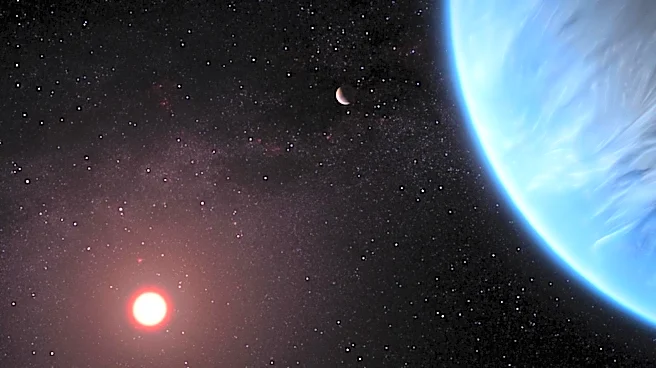
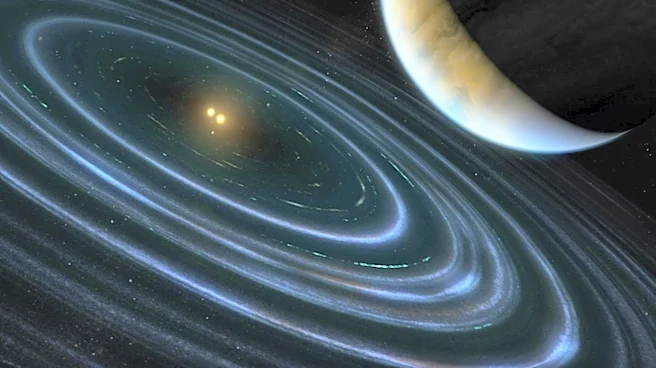
A new paper published in The Astrophysical Journal explores the potential for an Earth-sized planet to maintain a stable orbit within the habitable zone of a nearby binary star system, 70 Ophiuchi. This system, located approximately 5 parsecs from Earth,
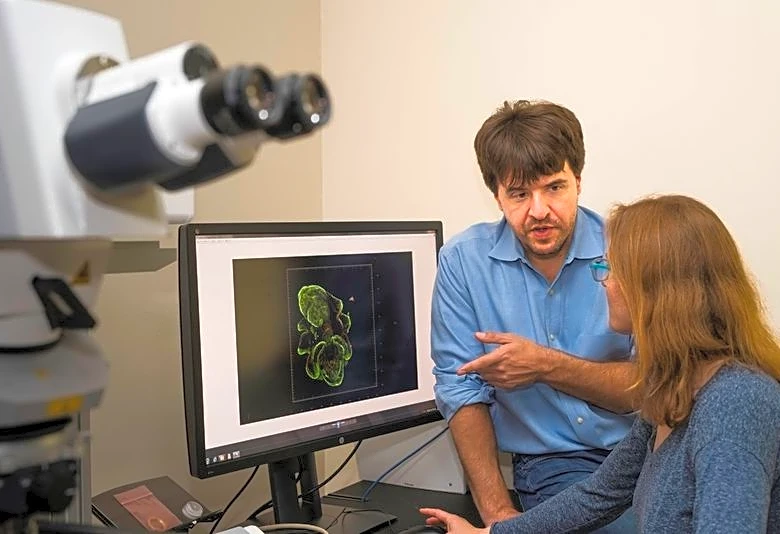
consists of two stars slightly smaller and cooler than our sun. Skylar D'Angiolillo, a doctoral student at UC Riverside, and her advisor, astrophysicist Stephen Kane, used computer simulations to model the gravitational interactions within the system. Their research indicates that stable orbits are indeed possible for an Earth-mass planet in the habitable zone around the primary star, despite the gravitational influence of the second star. While astronomers have observed 70 Ophiuchi for decades, no confirmed planets have yet been found orbiting either star.
Why It's Important?
This study challenges the conventional view that binary star systems might be too dynamically unstable to host habitable planets. Our solar system, with its single star, is considered somewhat unusual, as many stars exist in binary or multi-star systems. Demonstrating the potential for stable, habitable orbits in such systems significantly expands the scope of exoplanet searches and the possibilities for life beyond Earth. It suggests that the search for 'another Earth' should not be limited to systems resembling our own, but should also consider the diverse architectures of other planetary systems. This research provides a crucial step in dynamically vetting potential targets for future missions like NASA's Habitable Worlds Observatory, planned for the 2040s, by identifying systems capable of hosting potentially habitable worlds before direct observation attempts.
What's Next?
The immediate next step involves further analysis of other binary systems using similar dynamical modeling techniques to identify additional promising targets for exoplanet searches. While no planets have been confirmed in 70 Ophiuchi yet, the research suggests that an Earth-sized planet could exist there. This could motivate future observational efforts to detect such a planet, potentially even before the launch of the Habitable Worlds Observatory. The ongoing work will continue to refine our understanding of planetary dynamics in complex gravitational environments, contributing to the broader goal of finding and characterizing exoplanets that could support life. The insights gained from this study will be invaluable for guiding the design and targeting strategies of next-generation space telescopes.
Beyond the Headlines
The study delves into the intricate dance of celestial mechanics, specifically the gravitational interactions that govern planetary stability in multi-star systems. It highlights the power of computational modeling in astrophysics, allowing scientists to simulate complex scenarios that are difficult or impossible to observe directly. The concept of a 'habitable zone' itself is continually being refined, and this research contributes to a more nuanced understanding of what constitutes habitability in diverse stellar environments. The idea of a planet with two suns, once largely confined to science fiction, is becoming a scientifically plausible reality, pushing the boundaries of our imagination and our understanding of cosmic diversity. This work encourages a broader perspective on where life might arise, moving beyond Earth-centric assumptions about planetary systems.