



What's Happening?
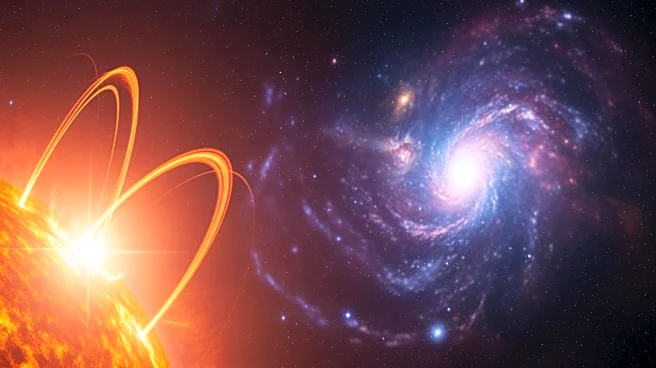
Recent videos from the Solar Orbiter and Chandra X-ray Observatory have captured significant solar and stellar phenomena. The Solar Orbiter recorded a solar flare, revealing a 'magnetic avalanche' where small magnetic reconnections led to a full flare eruption.
This provides new insights into solar activity and magnetic field dynamics. Meanwhile, Chandra's long-term observations of the Kepler supernova remnant show the slow-motion expansion of gases from a supernova that occurred 400 years ago. These observations help astronomers understand the mechanics of supernova explosions and their impact on the surrounding interstellar medium.
Why It's Important?
These observations are crucial for advancing our understanding of both solar and stellar processes. The solar flare video offers a detailed look at magnetic reconnection, a key process in solar physics that affects space weather and can impact Earth's technology. Understanding supernova remnants helps scientists learn about the life cycle of stars and the distribution of elements in the universe. These findings contribute to broader astrophysical knowledge, influencing fields such as space weather prediction and the study of cosmic element formation.
What's Next?
Further analysis of the data from these observations will continue, with scientists aiming to refine models of solar and stellar behavior. The Solar Orbiter will provide more detailed observations as it continues its mission, potentially capturing more solar flares and magnetic phenomena. Chandra's ongoing monitoring of supernova remnants will help build a more comprehensive picture of these cosmic events. Future missions and instruments may focus on capturing similar phenomena in other parts of the universe, expanding our understanding of stellar and solar dynamics.