




What's Happening?
Land managers in the Greater Yellowstone Ecosystem (GYE), encompassing federal, state, local, private, and Tribal lands, are increasingly utilizing the Resist-Accept-Direct (RAD) framework to address ecological transformations driven by climate change.
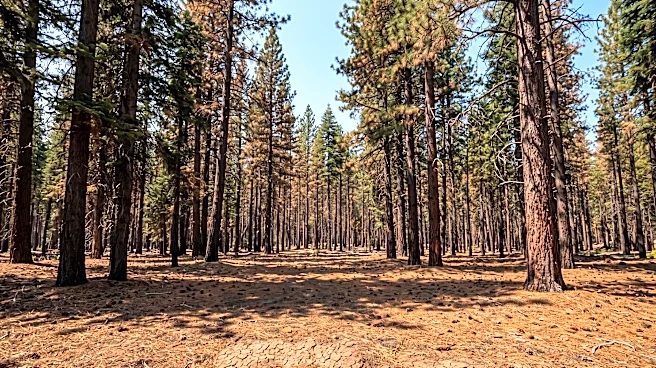
A study involving interviews with federal agencies and a regional non-profit revealed that while a common goal of promoting a resilient landscape exists, current management actions predominantly align with 'resist' strategies, aiming to maintain existing ecological conditions. This is often due to institutional mandates and policy constraints. However, there is a growing openness to implementing a mix of 'resist,' 'accept' (allowing transformations with minimal intervention), and 'direct' (guiding ecosystems toward desired new states) actions. For instance, managers are resisting change in whitebark pine and sagebrush systems, while considering directing change in Douglas-fir forests. The study highlights significant disparities in the age of management plans across units, with some relying on documents over two decades old, impacting their ability to incorporate up-to-date science and strategies.
Why It's Important?
This approach is crucial for the U.S. as it represents a proactive and adaptive strategy to manage vast and ecologically significant landscapes like the GYE in the face of accelerating climate change. The GYE, with its diverse ecosystems and critical wildlife habitats, serves as a vital natural resource. The reliance on 'resist' strategies, while understandable due to historical mandates, may prove insufficient as ecological changes become irreversible. The shift towards considering 'accept' and 'direct' actions signifies a necessary evolution in conservation philosophy, moving beyond simply preserving historical conditions to actively shaping future ecosystems. This has implications for national policy on public land management, potentially influencing how federal agencies like the National Park Service, U.S. Forest Service, and Bureau of Land Management allocate resources, develop management plans, and collaborate across jurisdictional boundaries to ensure the long-term health and functionality of these critical natural assets.
What's Next?
The GYE will likely see continued efforts to integrate the RAD framework more explicitly into management plans and practices. This will involve fostering greater cross-jurisdictional coordination and communication, particularly through entities like the Greater Yellowstone Coordinating Committee, to align diverse priorities and overcome institutional barriers. Managers will need to develop context-specific RAD strategies, tailoring approaches to different ecosystems and ecological conditions. This could include increased investment in research to better understand ecological tipping points and the effectiveness of various RAD actions. There may also be a push to update outdated management plans to reflect current climate science and adaptive strategies. The ongoing challenge will be to balance the need for active intervention with public expectations and legal frameworks that often favor maintaining historical baselines, potentially leading to policy reforms that support more flexible and adaptive management approaches.
Beyond the Headlines
The adoption of the RAD framework in the GYE reflects a profound philosophical shift in environmental management, acknowledging that some ecological changes are inevitable and that human intervention may be necessary to guide ecosystems towards new, functional states. This moves beyond a purely preservationist mindset to one of active stewardship in an era of rapid environmental change. Ethically, it raises questions about what constitutes a 'desired future' for an ecosystem and whose values should guide these decisions, especially given the diverse stakeholders including Tribal nations and private landowners. Culturally, it challenges the romanticized notion of untouched wilderness, suggesting that even iconic landscapes like the GYE require deliberate, adaptive management. The long-term implications could include a redefinition of 'conservation success' to include the successful adaptation of ecosystems to novel conditions, rather than solely the restoration of historical states, setting a precedent for other large-scale conservation efforts across the U.S. and globally.