
What's Happening?
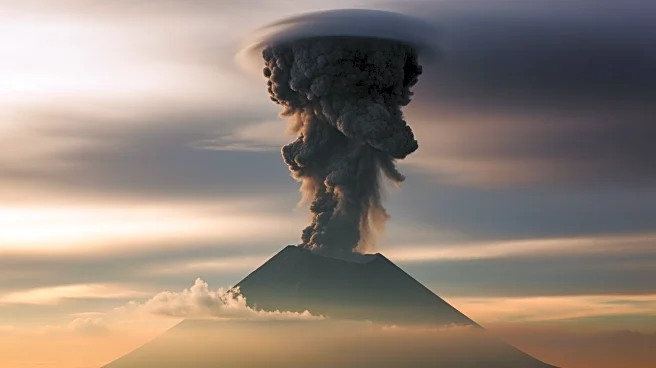
An international assessment report has been released detailing the atmospheric impacts of the Hunga volcano eruption in January 2022. The eruption, which occurred in the tropical Pacific, was significant
enough to be compared to the historic Krakatoa eruption of 1883. The report, involving over 100 scientists globally, including contributors from the University of Leeds, was published in Forschungzentrum Jülich. It highlights that the eruption increased global stratospheric water vapor by about 10%, a change that persists into 2025. Unlike typical large eruptions that warm the stratosphere, Hunga's eruption resulted in cooling. The report also notes minor effects on the Antarctic ozone hole and surface climate. Dr. Yunqian Zhu from the University of Colorado, Boulder, and Dr. Graham Mann from the University of Leeds, who co-led the report, emphasize the unique nature of this water-rich volcanic eruption and its implications for climate monitoring.
Why It's Important?
The findings of the Hunga eruption report are crucial for understanding the complex interactions between volcanic activity and climate change. The eruption's cooling effect on the stratosphere, despite the increase in water vapor, provides new insights into how such events can influence global climate patterns. This is particularly relevant for future climate projections and the ongoing efforts to meet the Paris climate targets. The report underscores the importance of international collaboration in monitoring and assessing the impacts of rare geophysical events. It also highlights the need for continued research into the long-term effects of volcanic eruptions on the ozone layer and climate, which are critical for informing global environmental policies and strategies.
What's Next?
The report suggests that the additional stratospheric water vapor from the Hunga eruption will continue to affect atmospheric chemistry and dynamics for several more years. This ongoing influence necessitates further monitoring and research to fully understand its long-term impacts. The findings will contribute to international assessments, such as those conducted by the United Nations Environment Programme and the World Meteorological Organization, ensuring that global protocols like the Montreal Protocol remain effective in protecting the ozone layer. Researchers will continue to use models to isolate the effects of the Hunga eruption from other variables, aiding in the accurate prediction of future climate scenarios.
Beyond the Headlines
The Hunga eruption's unique characteristics, particularly its water-rich nature, challenge existing models of volcanic impacts on climate. This event highlights the need for adaptive strategies in climate science to account for unexpected natural phenomena. The eruption's minimal impact on surface climate, despite significant stratospheric changes, raises questions about the thresholds at which volcanic activity can alter global temperatures. These insights could lead to a reevaluation of how volcanic eruptions are factored into climate models and predictions, potentially influencing future climate policy and research priorities.