



What's Happening?
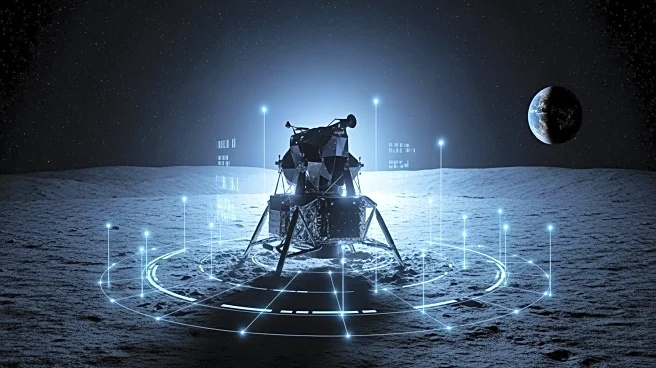
An international team of researchers has used artificial intelligence to identify potential locations of the Soviet Luna 9 spacecraft on the Moon. Luna 9, which made history in 1966 as the first human-made object to land on the Moon, has had its final
resting place remain a mystery. The team employed a machine learning model, YOLO-ETA, to analyze high-resolution images from NASA's Lunar Reconnaissance Orbiter Camera. They identified a promising site near lunar coordinates N latitude 7.02907° and longitude -64.32867°, which may contain remnants of the spacecraft. The findings, published in npj Space Exploration, could resolve a long-standing question from the Cold War era.
Why It's Important?
The use of AI in space exploration represents a significant advancement in the ability to analyze vast amounts of data and identify historical artifacts. This development not only aids in solving historical mysteries but also enhances the capabilities of space agencies to monitor and explore celestial bodies. The potential confirmation of Luna 9's location could provide insights into early space exploration technologies and strategies. Furthermore, the success of AI in this context may encourage its application in other areas of space research, potentially leading to new discoveries and a deeper understanding of our solar system.
What's Next?
The research team anticipates further confirmation of their findings when India's Chandrayaan-2 orbiter passes over the identified region. If confirmed, this discovery could lead to more detailed studies of the Luna 9 site, offering new insights into the spacecraft's design and mission. The success of the AI model may also prompt its use in locating other historical spacecraft and artifacts on the Moon and beyond. As space exploration efforts increase, AI technologies will likely play a crucial role in supporting missions and expanding our knowledge of the universe.