

What's Happening?
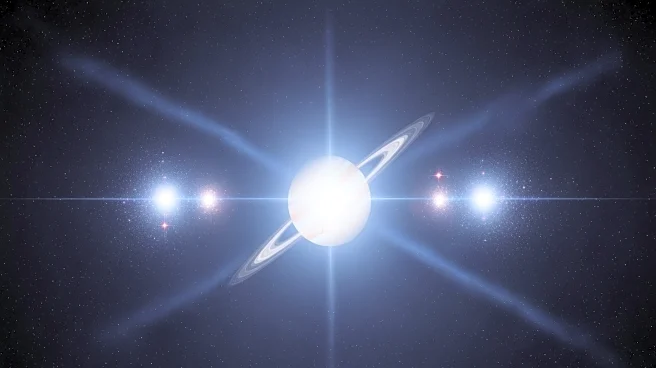
Astronomers have discovered a planetary system around the red dwarf star LHS 1903 that defies traditional planet-formation theories. Typically, rocky planets are found closer to their stars, with gas giants further away. However, this system includes
a rocky planet, LHS 1903 e, located farther from the star than expected. This finding suggests that planets in this system may have formed sequentially under varying conditions, challenging the conventional model of simultaneous planet formation within a protoplanetary disk.
Why It's Important?
The discovery of LHS 1903 e's unusual position in its planetary system prompts a reevaluation of planet-formation theories. It suggests that the processes leading to planet formation may be more diverse than previously thought. This could have significant implications for our understanding of planetary systems, including our own, and may lead to new models that better account for the diversity observed in exoplanetary systems. The findings highlight the need for more precise observational techniques to uncover and understand these anomalies.
What's Next?
The discovery encourages further investigation into the LHS 1903 system and similar anomalies in other systems. As observational technologies advance, astronomers will be able to detect more such systems, potentially leading to a broader understanding of planet formation. This could result in the development of new theoretical models that accommodate a wider range of planetary architectures, ultimately enhancing our comprehension of the universe's complexity.