



What's Happening?
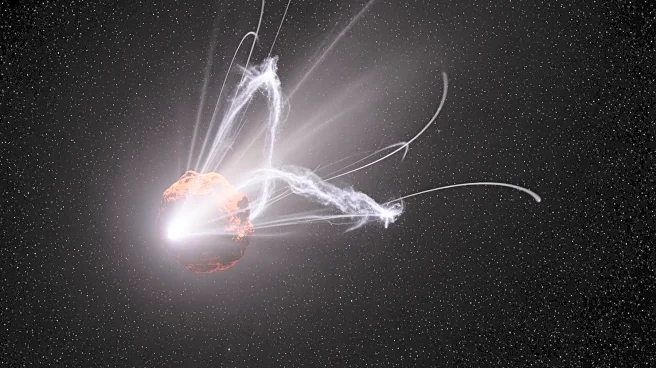
Interstellar comet 3I/ATLAS, the third known object from another star system to enter our solar system, has revealed unusual wobbling jets in its sun-facing 'anti-tail.' Observations indicate that these jets, stretching up to 620,000 miles, wobble every
7 hours and 45 minutes as the comet approaches the sun. This phenomenon, observed for the first time in an interstellar comet, provides a rare opportunity to study the physical behavior of a pristine body from another planetary system. The discovery was made using the Two-meter Twin Telescope at the Teide Observatory in Tenerife.
Why It's Important?
The study of 3I/ATLAS offers valuable insights into the composition and behavior of interstellar objects. Understanding the dynamics of its wobbling jets can enhance our knowledge of cometary physics and the interactions between cometary material and solar radiation. This research contributes to the broader field of planetary science by providing data on how objects from other star systems behave when exposed to the solar environment. The findings could inform future studies on the formation and evolution of comets, both within and beyond our solar system.