



What's Happening?
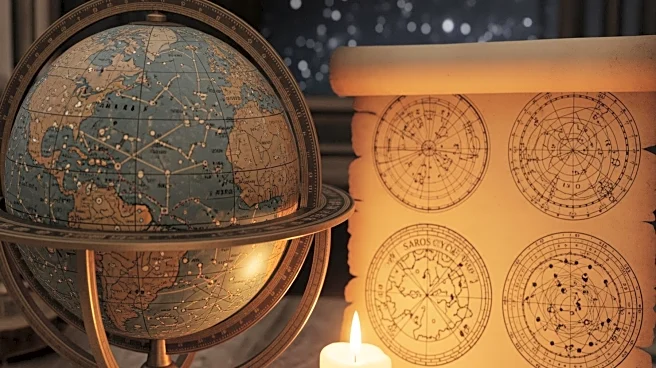
Ancient astronomers, including the Chaldeans and Greeks, used the saros cycle to predict solar eclipses. The saros cycle, lasting 6,585.3211 days, aligns four lunar cycles, allowing nearly identical eclipses to repeat every 18 years and 11 days. This
method enabled ancient skywatchers to predict eclipses with remarkable accuracy, despite lacking modern technology. The cycle's precision is due to its alignment with the Moon's orbital, synodic, nodal, and anomalistic periods. Although ancient predictions lacked subsecond accuracy, they were sufficient for practical purposes, demonstrating the advanced observational skills of early astronomers.
Why It's Important?
Understanding the saros cycle's role in ancient eclipse predictions highlights the sophistication of early astronomical practices. This knowledge underscores the importance of historical observations in the development of modern astronomy. The ability to predict eclipses was crucial for ancient societies, influencing cultural and religious practices. The saros cycle's discovery reflects the ingenuity of ancient astronomers, who laid the groundwork for contemporary scientific methods. This historical insight enriches the appreciation of human intellectual progress and the continuity of scientific inquiry across millennia.