





What's Happening?
OpenAI has reorganized its robotics division, reassigning researchers to other teams with the aim of accelerating robotics development through general-purpose AI models. Robotics researchers are now part of the main research team under Chief Research
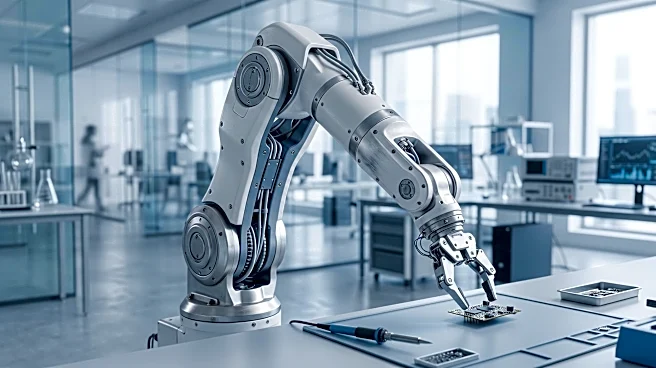
Officer Mark Chen, while applied robotics and hardware teams have joined Greg Brockman's Applied organization. This decision was made on short notice, leading to OpenAI's booth at the Conference on Robot Learning (CoRL) in Austin remaining empty. The company believes that advanced general-purpose models, such as GPT-6 Astra, can directly control robots, potentially reducing the need for specialized robotics models. An Nvidia study demonstrated an Astra-powered agent achieving a 74.8% success rate in simulated robotics tasks, outperforming specialized models at 51%. Additionally, in a new benchmark called StationeryBench, Astra completed 7 out of 100 tasks involving desk objects on robotic arms, while a specialized model, MolmoAct2, completed none. Astra also navigated and cleaned a kitchen using a humanoid robot in another test.
Why It's Important?
This strategic shift by OpenAI signifies a potential paradigm change in the field of robotics, moving away from highly specialized AI models towards more versatile, general-purpose AI for robot control. If successful, this approach could significantly accelerate the development and deployment of robots across various industries in the U.S. By leveraging powerful models like GPT-6 Astra, the complexity and cost associated with developing bespoke AI for each robotic application could decrease, making robotics more accessible and scalable. This could lead to advancements in automation, manufacturing, logistics, and even domestic applications, impacting labor markets and productivity. Companies investing in specialized robotics AI might face increased competition or a need to adapt their strategies, while those focusing on general AI development could gain a significant advantage. The success of this approach could also influence research directions in both AI and robotics, potentially leading to a convergence of these fields.
What's Next?
OpenAI's CEO, Sam Altman, is reportedly targeting a public robot demonstration for 2027, indicating a near-term goal for showcasing the capabilities of their general-purpose AI in robotics. The company also has long-term aspirations to build its own everyday robots. The ongoing research will likely focus on refining models like GPT-6 Astra to improve their performance and reliability in real-world robotic applications, moving beyond simulated environments. Further benchmarks and studies will be crucial to validate the effectiveness of general-purpose AI in complex robotic tasks. The industry will be watching to see if OpenAI's approach can overcome challenges related to cost, reliability, speed, and energy consumption, which specialized robotics models currently address. The success or failure of this strategy could influence investment in AI and robotics, potentially leading other major tech companies to re-evaluate their own robotics development strategies.
Beyond the Headlines
The shift towards general-purpose AI for robotics raises profound implications for the future of human-robot interaction and the nature of work. If AI models can control robots directly and perform a wide array of tasks, it could lead to a more integrated and autonomous robotic presence in daily life and industry. This development could spark ethical debates regarding job displacement, the safety of autonomous systems, and the extent to which AI should be entrusted with physical control in complex environments. The ability of AI to understand and interact with the physical world through robotics also brings closer the prospect of more advanced artificial general intelligence (AGI), as it demonstrates a deeper level of comprehension and adaptability. Furthermore, the competition between U.S. and international AI labs, particularly with advancements in China, highlights the geopolitical significance of leadership in this technological frontier, potentially impacting national security and economic competitiveness.