






What's Happening?
Researchers have identified a unique state of matter deep within Uranus and Neptune, where hydrogen moves in spiral paths under extreme pressure and heat. This discovery, published in Nature Communications, focuses on carbon hydride, which behaves in a way
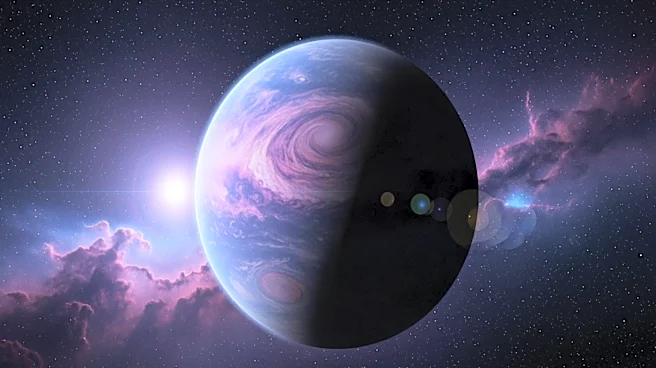
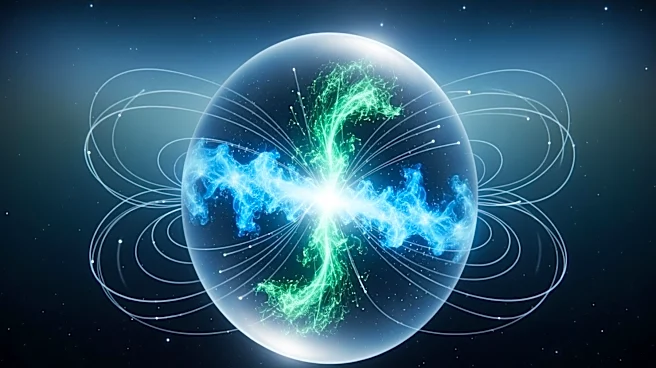
that blurs the line between solid and liquid. The study, led by Cong Liu and Ronald Cohen, reveals that hydrogen atoms follow helical paths within a rigid hexagonal lattice, creating a quasi-one-dimensional superionic state. This behavior is distinct from typical superionic materials, where atomic motion is multi-directional. The findings are significant as they provide insights into the unusual magnetic fields of these ice giants, which are tilted and offset from their centers.
Why It's Important?
The discovery of this new state of matter has significant implications for understanding planetary physics and magnetic fields. The unique movement of hydrogen affects how heat and electricity circulate within Uranus and Neptune, potentially explaining their unusual magnetic fields. This research enhances our understanding of planetary interiors, which is crucial as scientists continue to study over 6,000 identified exoplanets. The findings could lead to advancements in theoretical modeling and laboratory experiments, offering a deeper understanding of planetary formation and behavior under extreme conditions.
What's Next?
Future research will likely focus on further exploring the implications of this superionic phase on planetary magnetic fields and energy distribution. Scientists may conduct additional quantum simulations and laboratory experiments to validate these findings and explore their applicability to other celestial bodies. The study could also inspire new theoretical models to predict the behavior of materials under extreme conditions, potentially influencing the study of exoplanets and the search for life beyond Earth.
Beyond the Headlines
This discovery highlights the complexity and diversity of planetary interiors, challenging existing models of planetary formation and behavior. The unique hydrogen movement could lead to a reevaluation of how magnetic fields are generated and maintained in ice giants. Additionally, the study underscores the importance of interdisciplinary research, combining observational data, laboratory experiments, and theoretical modeling to advance our understanding of the universe.