



What's Happening?
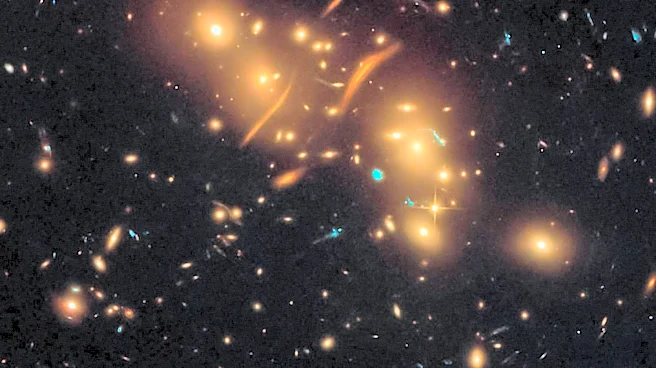
An international team of scientists has discovered 70 new gravitational lenses, significantly expanding the largest collections of confirmed lenses to date. This achievement was made possible by utilizing data from the DESI Legacy Imaging Surveys and employing
artificial intelligence, specifically a residual neural network, to identify potential candidates. The DESI Legacy Imaging Surveys, which created the largest 2D map of the universe, provided a vast dataset of 5.6-trillion-pixel images containing nearly four billion celestial objects. After the AI identified 76 gravitational lens candidates, a follow-up study led by Emerald Lin (UC Berkeley) and Ivonne Toro Bertolla (NSF NOIRLab) used the Multi-Unit Spectroscopic Explorer (MUSE) instrument on the European Southern Observatory's Very Large Telescope to spectroscopically confirm 70 of these candidates as true gravitational lenses. This process involved measuring the distances to both the lensing and background objects.
Why It's Important?
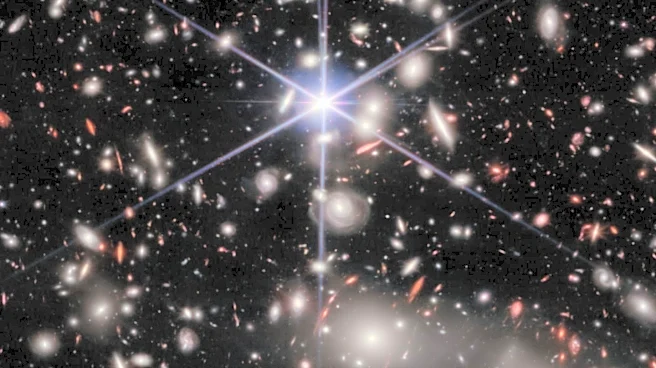
The discovery of these 70 new gravitational lenses is crucial for advancing the study of dark matter, galaxy evolution, and the overall structure of the universe. Gravitational lenses act as natural magnifying glasses, allowing astronomers to observe objects that would otherwise be too distant or faint. This expanded sample provides an essential foundation for probing the distribution of invisible dark matter, studying distant galaxies from the early universe, and refining measurements of the universe’s expansion rate. The integration of artificial intelligence in this discovery process highlights a transformative shift in astronomical research, enabling the systematic identification of rare cosmic phenomena that were previously discovered serendipitously. This methodology significantly accelerates the pace of discovery and allows for more efficient allocation of valuable telescope time, ultimately deepening humanity's understanding of cosmic evolution and fundamental cosmological models.
What's Next?
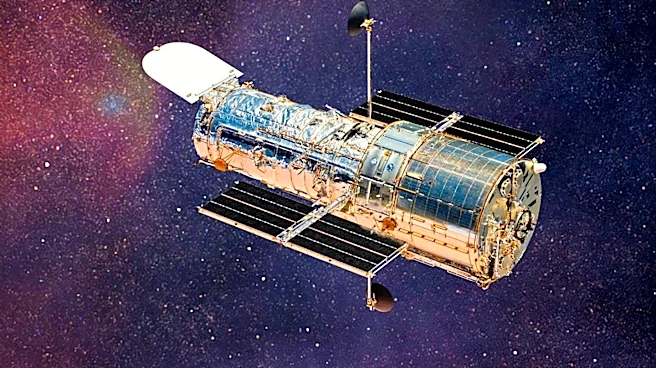
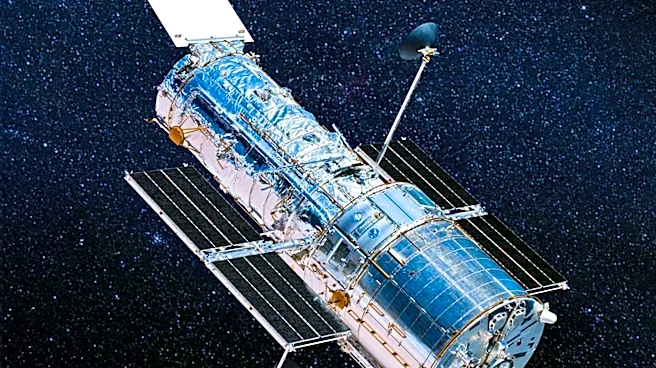
The newly confirmed gravitational lenses have been added to the DESI Strong Lens Foundry Project, which will serve as a valuable resource for the astronomical community for years to come. Researchers will combine observations from these lenses with data from other advanced facilities, such as the Hubble Space Telescope, the James Webb Space Telescope, the Nancy Grace Roman Space Telescope, and the NSF–DOE Vera C. Rubin Observatory’s Legacy Survey of Space and Time (LSST). This integrated approach will enable more comprehensive studies of dark matter distribution, detailed analyses of distant galaxies, and rigorous testing of various models of cosmic evolution. The continued application and refinement of AI-powered search techniques are expected to lead to further discoveries of rare celestial objects, transforming how astronomers conduct large-scale surveys and make new insights into the universe.
Beyond the Headlines
The successful application of artificial intelligence in identifying gravitational lenses signifies a profound shift in scientific discovery, moving beyond traditional observational methods to leverage computational power for pattern recognition in vast datasets. This development has broader implications for scientific fields beyond astronomy, suggesting that AI can unlock new frontiers in data-intensive research. Ethically, it raises questions about the role of human intuition versus algorithmic efficiency in scientific exploration and the potential for AI to introduce biases or overlook unexpected phenomena. Culturally, it reinforces the idea of humanity's continuous quest to understand its place in the cosmos, with technology serving as an increasingly powerful extension of human curiosity. The long-term impact could be a fundamental re-evaluation of how scientific hypotheses are generated and tested, with AI becoming an indispensable partner in the pursuit of knowledge.