





What's Happening?
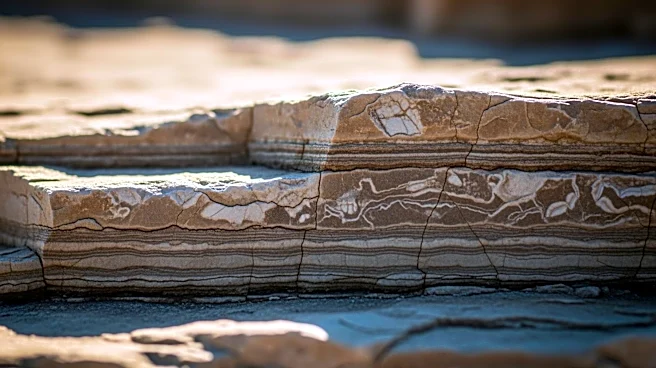
A team of geologists led by Jaesoo Lim from the Korea Institute of Geoscience and Mineral Resources has discovered stromatolites beneath a crater in South Korea, which was formed by a massive asteroid impact around 42,000 years ago. Stromatolites are
layered structures created by microbial mats and are among the oldest known evidence of life on Earth. This finding suggests that the heat from the asteroid impact may have created a hydrothermal environment similar to hot springs, allowing microbial communities to thrive. The discovery supports the theory that during the era of heavy bombardment billions of years ago, impact craters could have served as temporary refuges for early life on Earth. The Jeokjung-Chogye Basin, where the stromatolites were found, has been identified as an impact structure only recently, and further analysis revealed mineral signatures indicative of past hydrothermal activity.
Why It's Important?
This discovery is significant as it provides insights into how life might have originated and evolved on Earth. The presence of stromatolites in hydrothermal environments created by asteroid impacts suggests that such craters could have been crucial in providing the necessary conditions for early microbial life to develop. This finding also implies that similar environments could have existed elsewhere on Earth, potentially contributing to the rise of oxygen in the atmosphere through microbial activity. Understanding these processes is vital for reconstructing the history of life on Earth and could inform the search for life on other planets, such as Mars, where similar impact craters might harbor evidence of past life.
What's Next?
Further research is needed to explore other impact craters on Earth to determine if they also contain stromatolite-rich hydrothermal lakes. Such studies could provide more evidence of the role these environments played in the early development of life and the oxygenation of Earth's atmosphere. Additionally, the possibility of finding similar signatures on Mars suggests that future missions could focus on exploring Martian craters for signs of ancient life. This research could significantly enhance our understanding of life's potential existence beyond Earth.
Beyond the Headlines
The discovery of stromatolites in impact craters highlights the complex interplay between geological events and biological evolution. It suggests that life on Earth may have arisen from a combination of rare ingredients and events, emphasizing the uniqueness of our planet's history. This finding also raises questions about the potential for life to exist in similar environments elsewhere in the universe, challenging scientists to rethink the conditions necessary for life to thrive.