
What's Happening?
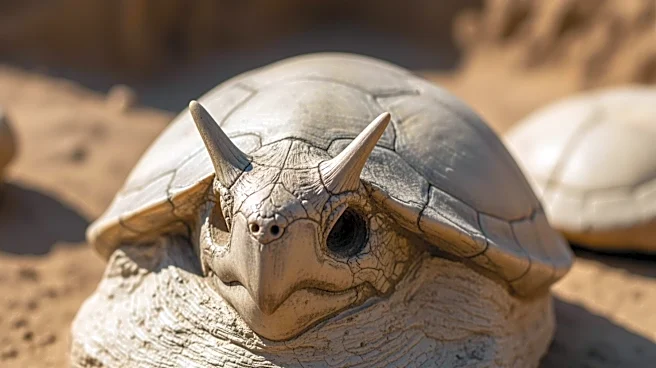
Paleontologists have identified a new species of meiolaniform turtle, named Patagoniaemys aeschyli, from the Maastrichtian age in northern Patagonia, Argentina. This discovery was made from fossilized
remains found in the Los Alamitos Formation, including parts of the skull, shell, vertebrae, and limb bones. The species is noted for its heavily armored body and horned skull, characteristics of the meiolaniform lineage. The shell of Patagoniaemys aeschyli is estimated to be about 80 cm in length and features unique ornamentation. This discovery provides insights into the survival of turtle lineages during the end-Cretaceous mass extinction event.
Why It's Important?
The discovery of Patagoniaemys aeschyli is significant as it sheds light on the resilience of certain turtle lineages during the mass extinction event that occurred 66 million years ago. This finding suggests that the extinction event did not severely impact Patagonian turtles, indicating a continuity of species across the Cretaceous-Paleogene boundary. This contributes to the understanding of faunal turnover and lineage persistence in southern chelonians, offering valuable information for paleontologists studying evolutionary patterns and extinction events.