



What's Happening?
The colonial colleges established in British America, including Harvard, William and Mary, Yale, Princeton, Columbia (King's College), and the University of Pennsylvania (College of Philadelphia), were predominantly modeled on the ancient English universities
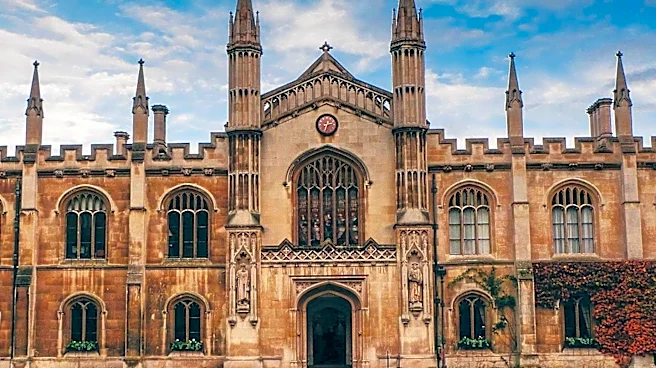
of Oxford and Cambridge. Founders, often Oxbridge graduates, transplanted English academic traditions such as the residential college system, tutorial instruction, classical curriculum, and a clerical mission to the New World. These institutions aimed to train clergy, lawyers, and a governing class, initially to prevent reliance on England for intellectual leadership. Harvard, founded in 1636, explicitly replicated Emmanuel College, Cambridge, focusing on a 'learned and godly ministry.' The College of William and Mary (1693) followed Oxford models, while Yale (1701) closely mirrored Cambridge. Even institutions like Princeton (1746) and Columbia (1754) adopted significant aspects of the English system, though some, like Franklin's College of Philadelphia (1749), attempted a more practical, American-centric approach.
Why It's Important?
The profound influence of Oxford and Cambridge on early American higher education is critical because it shaped the intellectual landscape that ultimately led to the American Revolution. These colonial colleges, by imparting a rigorous English-style liberal education, equipped their graduates with the very intellectual tools needed to challenge British authority. The curriculum, emphasizing classical languages, rhetoric, logic, and moral philosophy, trained students in critical thinking, argumentation, and persuasive writing. This intellectual foundation enabled figures like Thomas Jefferson and James Madison, alumni of these institutions, to articulate the philosophical underpinnings of independence and self-governance. The irony lies in Britain's cultural gift of education becoming the instrument of its own political displacement. This legacy underscores how educational systems can inadvertently foster revolutionary thought by empowering individuals with the capacity for independent reasoning and the articulation of grievances.
What's Next?
The enduring legacy of these English-modeled institutions continues to influence American higher education. While the curriculum and structure have evolved significantly, the foundational principles of liberal education, critical inquiry, and the development of informed citizens remain central. Future discussions in education may continue to explore the balance between traditional academic rigor and practical, modern applications, a tension present even in the colonial era with institutions like the College of Philadelphia. The historical context provided by this influence also informs ongoing debates about the role of universities in shaping national identity and political thought. As American society continues to evolve, the historical roots of its educational system in British traditions offer valuable insights into its strengths, weaknesses, and potential future directions, particularly in fostering civic engagement and intellectual leadership.
Beyond the Headlines
The transplantation of English university models to colonial America highlights a deeper cultural phenomenon: the complex interplay between colonial identity and metropolitan influence. While the colonists sought to replicate familiar institutions, the unique conditions of the New World inevitably led to adaptations and, eventually, a distinct American educational philosophy. The story of these colleges is not just about academic structures but also about the transmission of ideas, values, and intellectual traditions across an ocean. It reveals how education can be a powerful tool for both cultural preservation and revolutionary change. The emphasis on classical learning and moral philosophy in these early institutions also speaks to the prevailing intellectual currents of the Enlightenment, which profoundly shaped Western political thought. This historical narrative serves as a reminder that educational systems are not static but are dynamic reflections of societal aspirations, political realities, and evolving intellectual paradigms, capable of both reinforcing and challenging existing power structures.