








What's Happening?
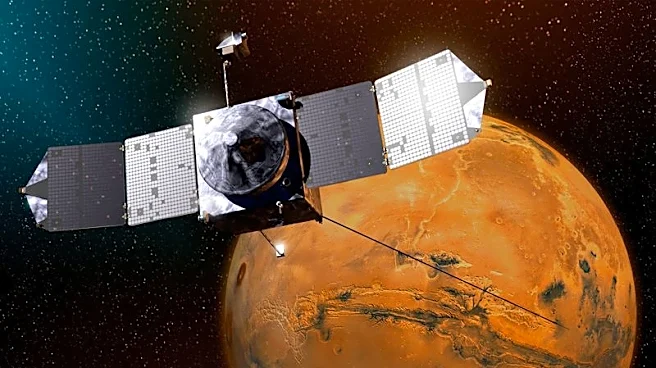
NASA's Psyche spacecraft successfully completed a close approach to Mars on May 15, 2026, coming within 2,864 miles of the planet's surface. This maneuver utilized Mars' gravity to increase the spacecraft's speed by 1,000 miles per hour and adjust its
orbital plane, setting it on a direct path to the metal-rich asteroid Psyche. The flyby allowed the mission team to calibrate the spacecraft's instruments, including imagers and spectrometers, by capturing images and data from Mars. The spacecraft is now on course to reach the asteroid Psyche, located in the main asteroid belt between Mars and Jupiter, by summer 2029.
Why It's Important?
The Psyche mission is significant as it aims to explore a metal-rich asteroid, which could provide insights into the building blocks of planet formation. Understanding the composition and characteristics of such asteroids can offer clues about the early solar system and the formation of terrestrial planets like Earth. The successful Mars flyby demonstrates the spacecraft's capabilities and the effectiveness of using planetary gravity assists to propel missions further into space. This mission could potentially revolutionize our understanding of planetary cores and the processes that shaped our solar system.
What's Next?
Following the Mars flyby, the Psyche spacecraft will continue its journey using solar-electric propulsion to reach the asteroid Psyche by August 2029. Upon arrival, it will enter a series of orbits around the asteroid to map its surface and gather scientific data. The mission will focus on determining the asteroid's composition, structure, and history, which could provide unprecedented insights into the nature of planetary cores. The data collected may also inform future missions and the development of technologies for asteroid mining and exploration.