







What's Happening?
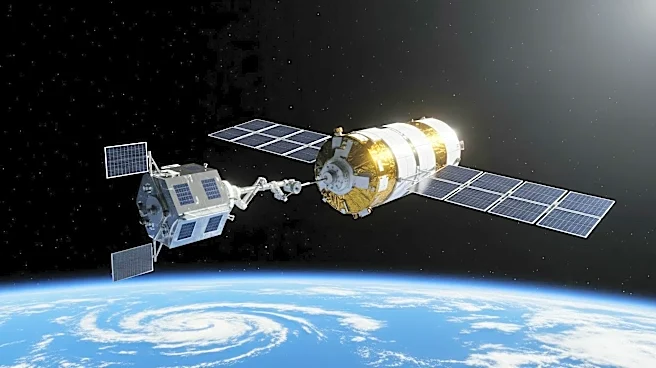
NASA has initiated the Swift Boost Mission to prevent the Neil Gehrels Swift Observatory from plummeting back to Earth. The observatory, launched in 2004, is at risk of re-entering the Earth's atmosphere due to its declining orbit. To address this, NASA launched the LINK
satellite via a Pegasus XL rocket from Kwajalein Atoll. The satellite, developed by Katalyst Space Technologies, is designed to attach to the Swift Observatory and tow it to a safer orbit. This mission aims to extend the observatory's operational life, allowing it to continue its research on gamma-ray bursts and other cosmic phenomena. The success of this mission could influence future efforts to preserve other aging telescopes, such as the Hubble Space Telescope.
Why It's Important?
The Swift Boost Mission is significant as it represents a cost-effective approach to extending the life of valuable scientific instruments in space. By preventing the Swift Observatory from burning up in the atmosphere, NASA can continue to gather critical data on gamma-ray bursts, which are among the most powerful explosions in the universe. This mission also serves as a demonstration of new capabilities in space exploration, showcasing the potential for commercial partnerships in maintaining and extending the life of space assets. The success of this mission could set a precedent for future operations to save other important telescopes, thereby preserving their unique scientific contributions.
What's Next?
If successful, the Swift Boost Mission could pave the way for similar operations to extend the life of other aging space telescopes. This could include the Hubble Space Telescope, which faces similar challenges with its orbit. The mission's outcome will likely influence NASA's strategies for maintaining its fleet of space observatories, potentially leading to more collaborations with commercial partners like Katalyst Space Technologies. Additionally, the mission's success could encourage further investment in technologies designed to service and extend the life of space-based instruments, ensuring continued scientific discovery.