



What's Happening?
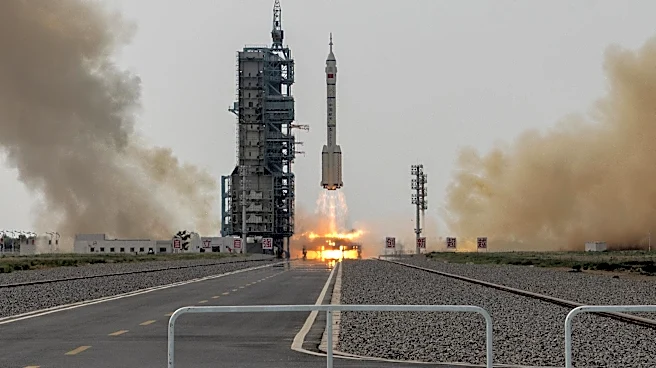
China's space launch capabilities are rapidly expanding, driven by a combination of state aerospace groups and commercial rocket companies. In 2025, China conducted 92 space launch missions, with 311 commercial satellites entering orbit, accounting for
84% of the year's total. The country has made significant strides in reusable rocket technology, achieving its first successful orbital-class booster recoveries in 2026. Key launch sites include Jiuquan, Wenchang, and mobile sea platforms, with the Hainan commercial spaceport expanding its capacity to over 60 launches annually. Notable rocket developments include the Long March 8A, Long March 12, and Kinetica-2, which offer varying payload capacities to different orbits. China is also focusing on industrial coordination, with groundbreaking projects for rocket supply chains and shared testing facilities to reduce duplicated investment.
Why It's Important?
The rapid expansion of China's space launch capacity has significant implications for global space commerce and strategic competition. By increasing its launch frequency and developing reusable rocket technology, China is positioning itself as a major player in the international space market, offering competitive services for satellite deployment. This growth enhances China's ability to deploy its own satellite constellations for communication, navigation, and Earth observation, strengthening its technological independence and strategic capabilities. The emphasis on commercial growth and shared infrastructure could also drive down costs for space access, potentially democratizing space for a wider range of users. For the U.S. and other spacefaring nations, China's advancements necessitate a re-evaluation of their own space strategies and investments to maintain technological parity and ensure national security in the increasingly contested domain of space.
What's Next?
The immediate future will see continued efforts by China to enhance its reusable rocket technology, focusing on repeat flights of recovered hardware, refurbishment requirements, and dependable turnaround times to prove commercial viability. The Hainan commercial spaceport's expansion to over 60 annual launches will be closely monitored to assess its operational efficiency and impact on overall launch cadence. Further development of shared testing facilities and industrial coordination will aim to streamline production and reduce costs. The international community will be watching for more details on contract prices and customer margins for Chinese launch services. Additionally, the deployment of more satellite internet payloads and the continued evolution of China's commercial space standards framework will be key indicators of its long-term trajectory in the global space industry.
Beyond the Headlines
Beyond the technical achievements, China's burgeoning space program carries profound geopolitical and economic implications. Its ability to independently launch a high volume of satellites and develop advanced space technologies challenges the traditional dominance of established space powers. This could lead to a more competitive and potentially fragmented global space economy, with new norms and regulations emerging. The dual-use nature of many space technologies means that advancements in commercial space can also bolster military capabilities, raising concerns about space security and arms control. Furthermore, China's approach to industrial coordination and state-backed commercial ventures offers a distinct model for space development, which could influence other emerging space nations. The long-term impact includes potential shifts in global power dynamics, increased competition for orbital resources, and the acceleration of space exploration and utilization for both scientific and commercial purposes.