
What's Happening?
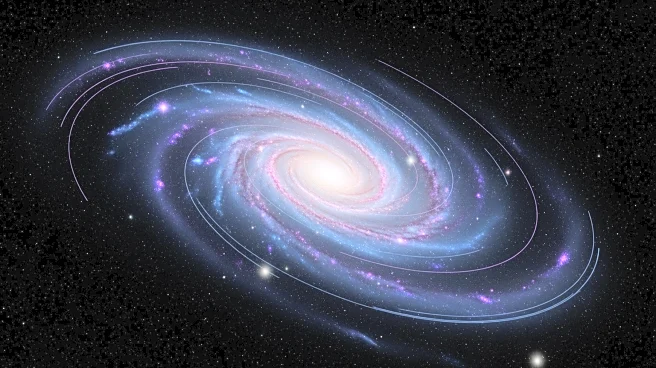
An international team of researchers, led by the University of Oxford, has identified the largest known rotating cosmic structure using data from South Africa's MeerKAT radio telescope. The structure consists
of 14 galaxies arranged in a string measuring 5.5 million light-years long and 117,000 light-years across, within a larger filament containing 280 galaxies. This discovery provides insights into how galaxies and stars form, as many of these galaxies appear to rotate in the same direction as the filament. The study, published in the Monthly Notices of the Royal Astronomical Society, suggests that these structures can influence galaxy spin more significantly than previously thought.
Why It's Important?
The discovery of such a massive rotating structure offers valuable insights into the formation and evolution of galaxies. Understanding these cosmic filaments can help scientists unravel the mysteries of dark matter, which is believed to make up a significant portion of the universe's mass. The findings could also inform future astronomical observations and enhance our understanding of the universe's large-scale structure. This research highlights the importance of advanced radio telescopes like MeerKAT in exploring the cosmos and expanding our knowledge of the universe's fundamental processes.
Beyond the Headlines
The study of these rotating structures could have broader implications for our understanding of cosmic evolution and the role of dark matter in shaping the universe. The alignment and rotation of galaxies within these filaments may provide clues about the forces at play in the early universe. As technology advances, researchers may uncover even larger and more complex structures, offering deeper insights into the universe's history and the fundamental forces that govern it.