






What's Happening?
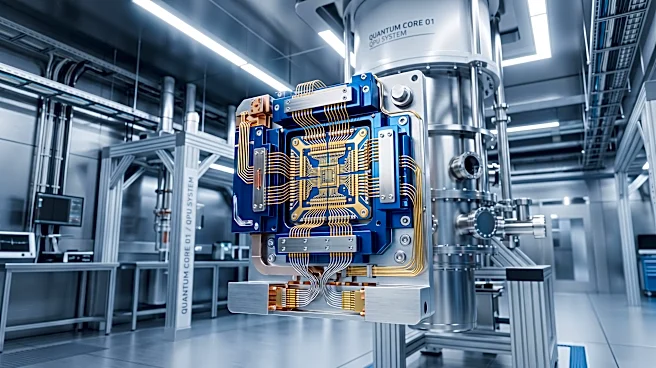
IBM announced significant advancements in its superconducting quantum computing roadmap at the Quantum Developer Conference (QDC 2026) on November 11, 2026. The company unveiled the IBM Quantum Nighthawk r3 processor, a dense superconducting quantum processor featuring
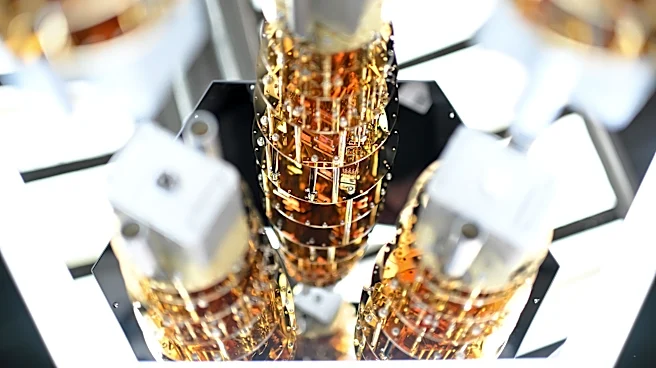
520 programmable qubits and 2,034 physical on-chip components. This processor is engineered to execute circuits with up to 10,000 two-qubit gate operations with high fidelity. IBM also detailed plans for a multi-chip scaling architecture, aiming to link two Nighthawk r3 processors within a single cryogenic system by 2027, creating a unified 1,040-qubit quantum computer. This modular expansion strategy utilizes ten high-fidelity superconducting interconnects, known as l-couplers, to overcome traditional thermal and cryogenic routing limitations. The Nighthawk r3 builds upon the Nighthawk r2 processors, which entered service in autumn 2026, demonstrating execution rates of up to 100,000 samples per second and supporting circuits exceeding 7,500 quantum gate operations. The new Nighthawk line employs a square-lattice topology for optimized qubit connectivity, reducing swap-gate overhead and enabling deeper algorithms. Key engineering breakthroughs include active mid-circuit measurement and high-speed qubit reset, crucial for mitigating decoherence errors and implementing quantum error mitigation routines.
Why It's Important?
The unveiling of the Nighthawk r3 processor and IBM's modular scaling strategy marks a critical step in bridging the gap between current noisy intermediate-scale quantum (NISQ) devices and future fault-tolerant quantum computing architectures. The ability to link multiple quantum chips coherently is essential for scaling quantum systems beyond the limitations of single-die monolithic designs. This development is particularly significant for the advancement of quantum low-density parity-check (qLDPC) codes, which require long-range chip-to-chip couplers to establish non-local stabilizer checks, thereby reducing the physical qubit overhead for error correction. The integration of IBM quantum hardware with high-performance computing (HPC) systems, as seen in the collaboration with Oak Ridge National Laboratory (ORNL), AMD, and the Quantum Science Center, highlights a growing convergence between quantum processing and classical supercomputing. This co-design approach is vital for real-time quantum error correction and the execution of complex hybrid quantum-classical workflows. Industries such as life sciences and energy are already seeing substantial computational gains, with firms like Algorithmiq reporting up to 19-fold speedups in molecular dynamics simulations for drug discovery, and E.ON demonstrating optimization routines for grid load balancing.
What's Next?
Following the QDC 2026 conference, IBM confirmed that the Nighthawk r2 will remain the primary production workhorse for the IBM Quantum Network throughout 2026 and early 2027, with System Two installations expanding globally. Fabrication and packaging validation for the Nighthawk r3 will continue through 2027. The first dual-chip 1,040-qubit modular systems are slated for internal benchmarking in mid-2027, with selective academic cloud deployment expected in late 2027. Concurrently, open-source updates to the Qiskit software development kit will be released. These updates will introduce native transpiler passes specifically designed for square-lattice routing and l-coupler latency management, allowing computational researchers worldwide to pre-compile and benchmark multi-chip circuit architectures before the physical hardware becomes widely available. The 2027 milestone of linking two Nighthawk r3 dies via l-couplers will be crucial for validating the preservation of quantum entanglement and coherent phase relationships across physical chip boundaries, with a target gate error rate below one percent. This demonstration is a prerequisite for IBM’s planned 2029 Starling architecture, which aims to execute 100 million quantum operations across 200 fully error-corrected logical qubits.
Beyond the Headlines
The architectural shift embodied by the Nighthawk r3, particularly its square-lattice topology and modular interconnects, represents a fundamental re-engineering of quantum processor design. This move away from traditional heavy-hexagonal lattice arrangements directly impacts the efficiency of quantum circuit compilation, allowing for the synthesis of deeper algorithms with fewer physical gate operations. The emphasis on active mid-circuit measurement and high-speed qubit reset is not merely an incremental improvement but a critical enabler for practical quantum error mitigation routines, moving the field closer to fault-tolerant quantum computing. The integration of quantum hardware with classical HPC systems, as exemplified by the ORNL collaboration, signals a broader trend towards hybrid computing paradigms where the strengths of both quantum and classical systems are leveraged. This convergence will necessitate new approaches to software integration, scheduling, and low-latency classical processing, driving innovation in both quantum software and classical supercomputing infrastructure. The long-term implications include the potential for quantum computers to tackle problems currently intractable for even the most powerful classical supercomputers, opening new frontiers in materials science, drug discovery, and complex optimization problems, fundamentally reshaping computational capabilities across various scientific and industrial domains.