







What's Happening?
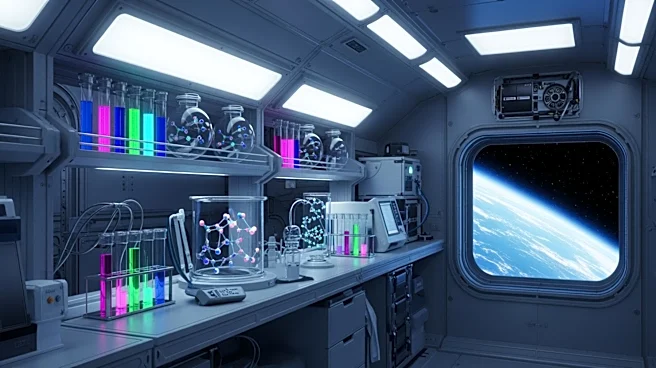
NASA is conducting extensive research on microbiology and chemistry aboard the International Space Station (ISS) to gain insights into health protection both on Earth and in space. The research involves studying how bacteria respond to microgravity conditions,
with samples being processed in the Kibo laboratory module. This work is part of the Odyssey biotechnology investigation, which aims to document the genetic function of microbes. The research could lead to new methods for protecting humans and equipment in harsh environments. Additionally, the crew is testing a new spacesuit prototype designed by the European Space Agency (ESA) for use inside spacecraft. The ISS crew is also involved in packing a SpaceX Dragon cargo spacecraft with scientific experiments and station gear for return to Earth.
Why It's Important?
The research being conducted on the ISS is vital for advancing our understanding of how microgravity affects biological processes, which is crucial for long-term space missions and the development of new pharmaceuticals. The insights gained could lead to improved health protection strategies for astronauts and have applications in medical research on Earth. The testing of new spacesuit designs is also significant as it contributes to the development of more effective and comfortable gear for astronauts, enhancing their ability to work in space. These advancements are essential for future space exploration missions, including those planned under NASA's Artemis program.
What's Next?
The ongoing research aboard the ISS will continue to provide valuable data that can be used to improve health protection measures in space and on Earth. The results of the spacesuit testing will inform the final design, ensuring it meets the ergonomic requirements for space missions. The SpaceX Dragon cargo spacecraft will return to Earth with scientific experiments and station gear, allowing scientists to analyze the data and further refine their research. NASA's continued focus on microbiology and chemistry research will play a critical role in preparing for future missions to the Moon and Mars.