






What's Happening?
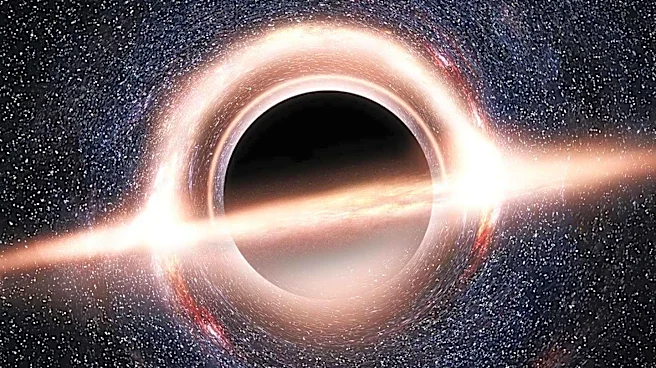
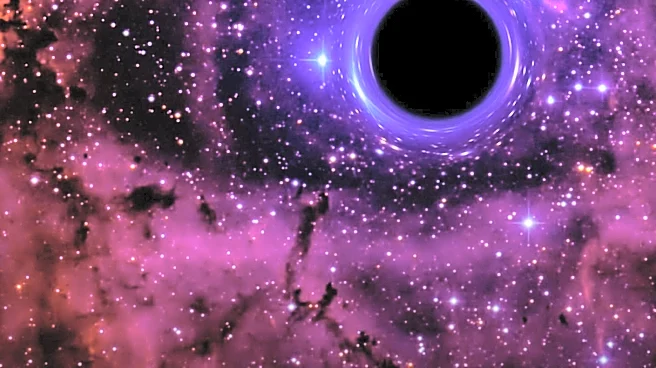
The Gaia spacecraft has identified three 'quiet' stellar-mass black holes, including Gaia BH3, that orbit companion stars without actively consuming their material. These black holes are difficult to detect directly because they do not emit bright X-rays
or jets like active black holes. Instead, their presence is inferred by observing their gravitational effect on nearby objects, specifically the subtle wobbles in the motion of their companion stars. While Gaia BH3 is in a wide binary system, consistent with expectations for black hole formation, the other two, BH1 and BH2, are in much closer orbits. This close proximity challenges existing theories on how such systems form, as a large star expanding before collapsing into a black hole would typically engulf a close-orbiting companion, leading to a merger rather than a stable binary.
Why It's Important?
The discovery of these close-orbiting quiet black holes is important because it suggests that the formation mechanisms for black hole binaries are more complex than previously understood. The traditional model of a large star expanding and then collapsing into a black hole would predict that close companions would be consumed. The existence of BH1 and BH2 in tight orbits necessitates alternative explanations, such as the Roche Lobe Overflow process. In this scenario, the outer layers of an expanding star are captured by a smaller companion without causing the two stars to spiral into each other, allowing the smaller star to maintain a stable orbit while the larger one collapses into a black hole. This finding pushes the boundaries of astrophysical modeling and requires a re-evaluation of stellar evolution and binary system dynamics, impacting our understanding of how a significant portion of black holes in the Milky Way might have formed.
What's Next?
With only three such systems observed so far, further research is needed to confirm the Roche Lobe Overflow model or propose other formation mechanisms. Astronomers will continue to use data from the Gaia spacecraft and other observatories to search for more quiet black holes and analyze their orbital characteristics. The precision of Gaia's motion measurements will be crucial in identifying additional candidates. Future studies will likely involve detailed simulations and theoretical modeling to explore various scenarios that could lead to the formation of close-orbiting black hole binaries. Confirming the Roche Lobe Overflow model would provide a significant advancement in understanding stellar evolution and the life cycles of massive stars, while disproving it would necessitate entirely new theories for these enigmatic systems. The ongoing collection of data will be vital in building a more robust statistical sample to test these hypotheses.
Beyond the Headlines
The existence of quiet black holes highlights a broader challenge in astronomy: detecting objects that do not emit light or other strong signals. This necessitates indirect observation methods, pushing the limits of current astronomical instrumentation and data analysis techniques. The study of these systems also has implications for understanding the distribution and population of black holes within our galaxy, many of which may be 'quiet' and thus currently undetected. Unraveling their formation history could shed light on the conditions prevalent in the early universe and the processes that shaped galactic structures. Furthermore, the interplay of gravitational forces in binary systems, especially those involving black holes, offers a natural laboratory for testing the limits of general relativity and exploring potential deviations from its predictions under extreme conditions. This ongoing quest to understand black holes contributes to our fundamental knowledge of the universe's most mysterious objects.