



What's Happening?
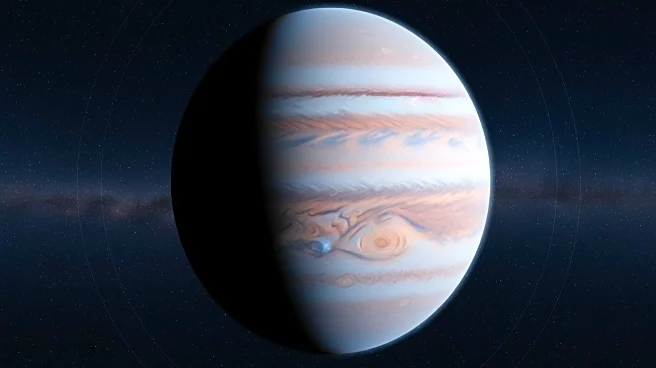
NASA's Juno mission has provided new insights into Jupiter's dimensions, revealing that the planet is slightly smaller and more 'squashed' than previously thought. By utilizing radio occultation data from 13 flybys, scientists determined that Jupiter is about
8 kilometers narrower at the equator and 24 kilometers flatter at the poles. This method involves sending radio signals through Jupiter's ionosphere, allowing scientists to measure changes in frequency to calculate atmospheric conditions. These findings update previous measurements from the 1970s by NASA's Pioneer and Voyager missions. The new data is crucial for calibrating models of giant exoplanets, aiding astronomers in interpreting data from distant planets.
Why It's Important?
The updated measurements of Jupiter's size and shape have significant implications for the field of astronomy, particularly in the study of exoplanets. Jupiter serves as a critical calibration standard for modeling giant planets in other star systems. Accurate data on its dimensions allows for better interpretation of exoplanetary data, enhancing our understanding of planets beyond our solar system. This advancement underscores the importance of continuous space exploration and data collection, as it refines our knowledge of planetary science and supports the development of more precise astronomical models.
What's Next?
The Juno mission continues to provide valuable data that will likely lead to further discoveries about Jupiter and its atmospheric dynamics. As scientists analyze more data from Juno's flybys, they may uncover additional insights into the planet's internal structure and weather patterns. This ongoing research will contribute to a deeper understanding of gas giants, both within our solar system and in distant star systems, potentially influencing future space missions and the search for habitable planets.