
What's Happening?
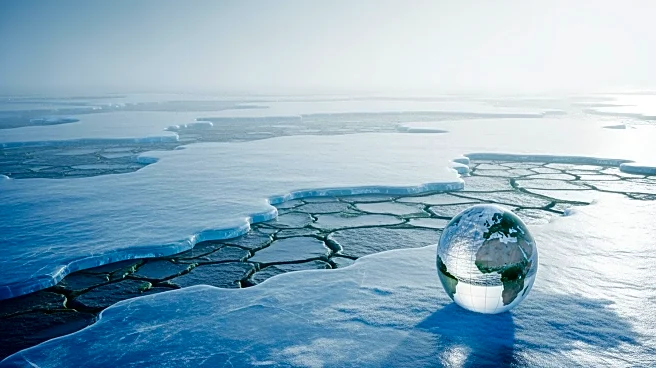
Researchers at the University of Southampton have discovered that Earth's climate did not completely halt during the Cryogenian Period, a time often referred to as Snowball Earth. This period, occurring
between 720 and 635 million years ago, was previously thought to have been characterized by a complete shutdown of the planet's climate system, with massive ice sheets covering much of the globe. However, a new study published in Earth and Planetary Science Letters suggests that climate fluctuations continued on yearly, decadal, and even century-long timescales during this period. The research is based on the analysis of varves, or layered rocks, from the Garvellach Islands off Scotland's west coast, which formed during the Sturtian glaciation. These findings indicate that the climate system has an innate tendency to oscillate, even under extreme conditions.
Why It's Important?
The study challenges the long-held belief that Snowball Earth was a period of complete climatic stasis, suggesting instead that the climate system remained active to some extent. This discovery has significant implications for understanding Earth's climate resilience and sensitivity to extreme conditions. It suggests that even during the most severe ice ages, the climate system could be 'kicked into motion,' providing insights into how planets, including Earth, might respond to major disturbances. This research could inform current climate models and improve predictions about how Earth's climate might behave under future extreme conditions, such as those induced by human activity.
What's Next?
The findings open new avenues for research into ancient climate systems and their modern analogs. Future studies may focus on identifying other geological records that could provide further evidence of climate variability during Snowball Earth. Additionally, the research team plans to continue exploring the implications of their findings for understanding the resilience of Earth's climate system. This could involve more detailed climate simulations to explore the conditions under which climate oscillations can occur, even in a largely frozen world.
Beyond the Headlines
The study's implications extend beyond the scientific community, as it highlights the potential for Earth's climate system to adapt and respond to extreme conditions. This resilience could be crucial in the context of current climate change challenges. The research also underscores the importance of geological records in reconstructing past climate events, which can provide valuable lessons for managing future climate risks. Furthermore, the study may influence how scientists approach the search for life on other planets, as it suggests that even planets with extreme climates could harbor dynamic climate systems.