





What's Happening?
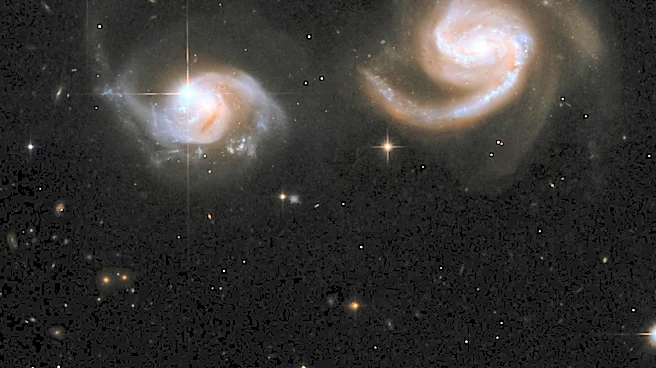
The Vera C. Rubin Observatory in Chile has captured an image of the Cosmic Evolution Survey Deep Field, revealing over 650,000 galaxies and more than 75,000 stars. The observatory's camera, the largest ever built, is part of a 10-year mission to create
a time-lapse record of the southern sky. The COSMOS field, first photographed by the Hubble Space Telescope, serves as a reference target for the observatory's new telescope. The Rubin Observatory aims to add the dimension of time to existing observations, enhancing the understanding of transient and variable objects.
Why It's Important?
The Rubin Observatory's capabilities represent a significant advancement in astronomical research, allowing scientists to study the universe in unprecedented detail. By capturing a vast number of galaxies and stars, the observatory contributes to the understanding of cosmic evolution and the dynamics of celestial objects. This research supports ongoing efforts to explore the universe's mysteries, providing valuable data for future scientific discoveries.