
What's Happening?
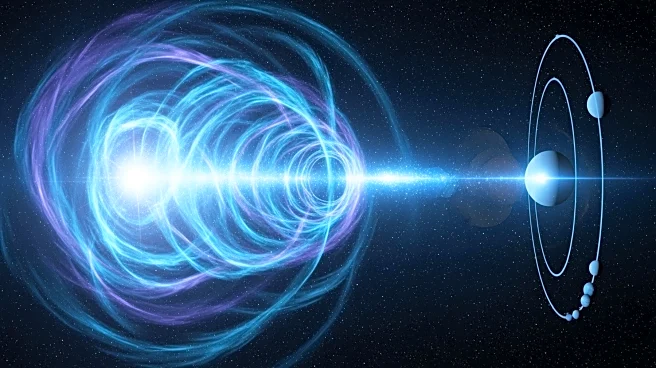
Recent observations have revealed a cosmic interstellar channel, or tunnel, connecting our solar system to distant stars. This discovery was made by astronomers from the Max Planck Institute using data
from the eRosita instrument. The analysis shows a channel of hot, low-density plasma stretching from our solar system toward distant constellations. This region, known as the Local Hot Bubble, is about 300 light years across and was formed by supernova explosions that heated the surrounding gas. The eRosita X-ray observatory, part of the Spectrum-Roentgen-Gamma mission, has been instrumental in capturing soft X-ray emissions to chart hot gas in space and investigate the surroundings of our neighborhood. The findings suggest a network of channels connecting star-forming regions and pockets of heated gas.
Why It's Important?
The discovery of this cosmic tunnel is significant as it provides new insights into the structure and dynamics of our cosmic neighborhood. Understanding these interstellar channels can help scientists learn more about the distribution of matter and energy in space, which is crucial for understanding the formation and evolution of galaxies. The presence of these channels challenges previous assumptions about the emptiness of space and highlights the complexity of the interstellar medium. This research could lead to advancements in astrophysics and improve our understanding of cosmic phenomena, potentially impacting future space exploration and technology.
What's Next?
Further exploration of these cosmic channels will require more sensitive instruments and deeper surveys. New X-ray missions and refined models of hot gas distribution are expected to improve our understanding of these structures. Astronomers aim to fill in more of the cosmic map and explain how these tunnels affect cosmic rays, dust flow patterns, and stellar wind dynamics. As technology advances, these discoveries may redefine our understanding of the cosmos and our place within it.
Beyond the Headlines
The discovery of these cosmic channels offers a reminder that even our own cosmic backyard holds surprises. These channels challenge old assumptions and add complexity to the picture of what lies between our Sun and the nearest stars. The findings suggest that ancient supernova events have shaped a connected patchwork of interstellar matter, influencing the conditions we find today. This research highlights the dynamic processes that have sculpted the interstellar medium over millions of years.