





What's Happening?
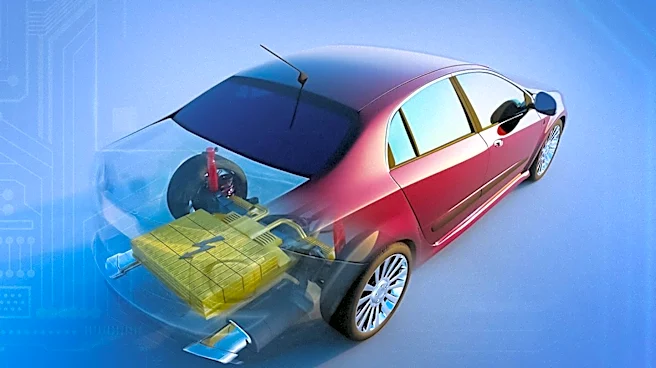
A recent study conducted by researchers at Shanghai Dianji University in China has revealed that aggressive driving styles can cause electric vehicle (EV) batteries to degrade 2.5 times faster than eco-friendly driving. The findings, published in Scientific
Reports, indicate that hard acceleration and deceleration, along with excessive demands on battery current, are primary contributors to this accelerated aging. The research team analyzed a full year of real driving data from 15 EVs in Guangzhou in 2022, recording usage data every 10 seconds across typical urban, suburban, and highway conditions. This data was then fed into a battery-aging model to predict capacity loss over 1,000 charge-discharge cycles. The study found that the smoothest driving style resulted in a 21.15 percent loss of maximum battery capacity, while the most aggressive style led to a substantial 53.22 percent loss.
Why It's Important?
The accelerated degradation of EV batteries due to aggressive driving has significant implications for consumers and the automotive industry in the U.S. EV batteries represent approximately a quarter of a vehicle's total retail cost, making their longevity a critical factor in ownership expenses and vehicle residual value. Faster degradation means more frequent and costly battery replacements for consumers, potentially increasing the total cost of EV ownership and impacting their appeal. For the U.S. automotive industry, which is heavily investing in EV production and promoting adoption, this research highlights the importance of educating drivers on optimal driving habits to maximize battery life. It also underscores the need for continued advancements in battery technology to withstand varied driving behaviors and for manufacturers to consider incorporating features that encourage more efficient driving. The findings could influence insurance premiums for EV owners and impact the resale market for used EVs, as battery health is a key determinant of value.
What's Next?
In response to these findings, EV manufacturers and policymakers may explore various strategies to mitigate battery degradation. This could include developing in-car systems that provide real-time feedback on driving efficiency, offering incentives for eco-driving, or integrating advanced battery management systems that better protect against aggressive usage. Educational campaigns aimed at EV owners could also become more prevalent, emphasizing the financial and environmental benefits of smoother driving. Furthermore, the research may spur further studies into battery chemistry and design to enhance resilience against aggressive driving patterns. The long-term implications could also influence the development of battery warranties and service plans, potentially leading to more nuanced terms based on driving behavior data. As EV adoption continues to grow in the U.S., understanding and addressing factors that impact battery longevity will be crucial for sustainable growth and consumer satisfaction.
Beyond the Headlines
Beyond the immediate financial and operational implications, this study touches upon broader themes of consumer behavior and technological adaptation. It highlights the often-overlooked human element in the performance and longevity of advanced technologies like EVs. The findings suggest a potential shift in how vehicle ownership is perceived, moving beyond just initial purchase price to include the ongoing impact of user habits on long-term costs and environmental footprint. Ethically, it raises questions about data privacy if driving behavior is monitored for warranty or insurance purposes. Culturally, it could foster a greater appreciation for 'eco-driving' as a responsible and economically beneficial practice, potentially influencing driving norms. This research also underscores the continuous learning curve associated with new technologies, where user education and behavioral adjustments are as important as the technological advancements themselves in realizing the full benefits of the EV revolution.