





What's Happening?
A federal judge has partially denied a motion to dismiss a civil rights lawsuit alleging anti-Asian bias in college admissions, allowing a case against the University of Washington to move forward. The lawsuit was filed by Nan Zhong and his son, Stanley
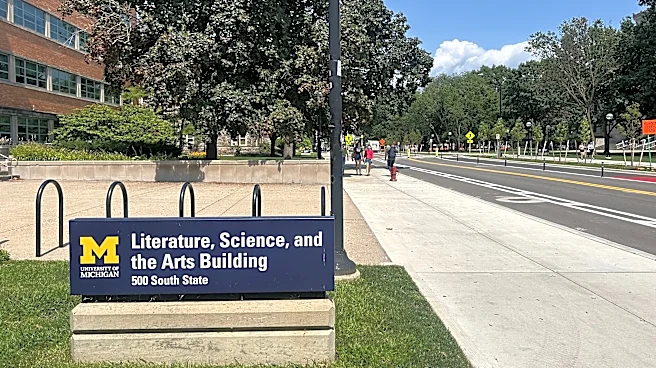
Zhong, who claim that several elite institutions, including the University of California system, the University of Washington, the University of Michigan, and Cornell University, engaged in racially discriminatory admissions practices. Stanley Zhong, a 2023 graduate of Gunn High School in Palo Alto, had an exceptional academic record, including a 1590 SAT score, a 4.42 weighted GPA, and a top 9% class ranking, yet was rejected by 16 of the 18 colleges he applied to. He was later hired by Google as a full-time software engineer, a position typically requiring a Ph.D. or equivalent experience. The judge's ruling specifically allows Stanley's Title VI claims against the University of Washington to proceed, enabling the family to request internal documents, communications, and admissions data during discovery.
Why It's Important?
This legal development is significant as it challenges the admissions practices of major U.S. universities and could have far-reaching implications for higher education. The lawsuit highlights ongoing concerns about potential anti-Asian bias in college admissions, an issue that has been a subject of debate and legal challenges for years. If successful, the case could lead to increased scrutiny of how universities evaluate applicants and potentially force changes in admissions policies to ensure fairness and equal opportunity for all racial groups. The fact that a highly qualified student like Stanley Zhong, who was subsequently hired by a leading tech company, faced numerous rejections from universities, underscores the perceived disparity in the admissions process. This case could set a precedent for how future racial discrimination claims in college admissions are handled, potentially impacting thousands of Asian-American applicants and the broader landscape of U.S. higher education.
What's Next?
With the judge's ruling, the lawsuit against the University of Washington will now proceed to the discovery phase. This will involve the Zhong family gaining access to internal university documents, communications, and admissions data, which they believe will support their claims of racial discrimination. The University of Washington, while pleased that many claims and two of the three plaintiffs were dismissed, will likely continue to defend its admissions policies, asserting compliance with state and federal laws prohibiting race-conscious decisions. The outcome of this case could influence similar lawsuits against other universities and potentially lead to legislative or policy changes regarding affirmative action and diversity in college admissions. The Zhong family has indicated that many other Asian-American families have shared similar experiences, suggesting that this case could be part of a larger movement to address perceived biases in the admissions process.
Beyond the Headlines
The case delves into the complex and often contentious issue of racial equity in U.S. higher education. While universities aim for diverse student bodies, the methods used to achieve this diversity are under constant legal and public scrutiny. The lawsuit raises questions about the balance between holistic review processes and objective academic merit, particularly for high-achieving Asian-American students who often feel penalized in competitive admissions. The broader implication is a re-evaluation of what constitutes 'fairness' in college admissions and whether current practices inadvertently create disadvantages for certain demographic groups. This legal battle could contribute to a national conversation about the role of race in educational opportunities and potentially reshape the future of college admissions policies across the country, impacting not only students but also the ethical and cultural fabric of academic institutions.