






What's Happening?
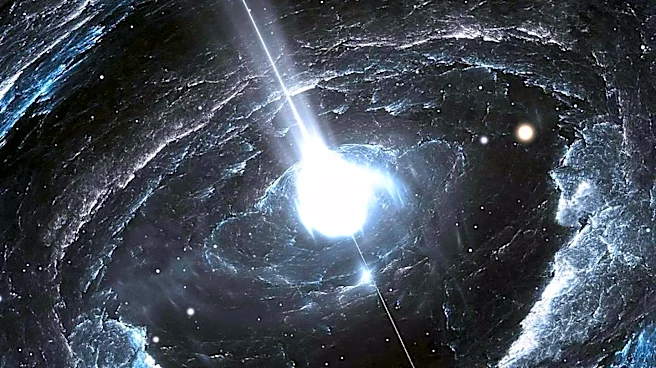
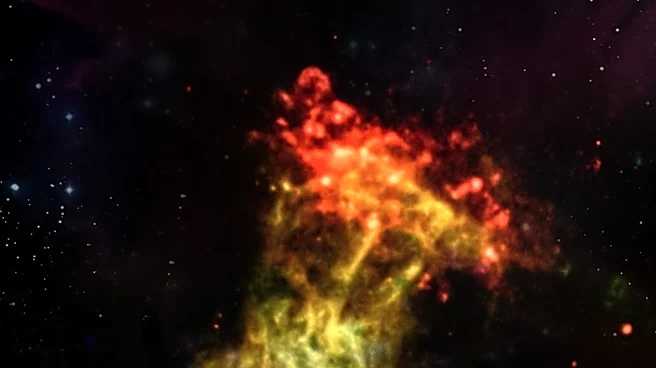
NASA's Imaging X-ray Polarimetry Explorer (IXPE) has successfully measured the magnetic fields of the pulsar PSR J1101-6101, located in the Lighthouse Nebula, for the first time. This achievement was made possible through a composite image combining X-ray data
from NASA's Chandra X-ray Observatory and IXPE, along with radio emissions from the Australia Compact Telescope Array. The pulsar, a rapidly spinning neutron star with a strong magnetic field, is a subject of interest due to its extreme properties. The findings, published in the Astrophysical Journal, provide new insights into the structure and behavior of such cosmic objects, enhancing our understanding of the universe's fundamental workings.
Why It's Important?
This breakthrough in measuring the magnetic fields of a pulsar directly contributes to the field of astrophysics by offering a deeper understanding of the extreme environments surrounding neutron stars. Such insights are crucial for developing models of stellar evolution and the dynamics of magnetic fields in space. The ability to measure these fields directly also opens up new avenues for research into the fundamental forces and particles that govern the universe. This advancement underscores NASA's ongoing efforts to explore and understand the cosmos, potentially leading to new discoveries about the nature of matter and energy.
What's Next?
Following this successful measurement, further studies are expected to focus on other pulsars and similar cosmic phenomena to expand our understanding of their magnetic properties. NASA may also explore the potential for IXPE and other observatories to collaborate on additional projects, leveraging their combined capabilities to study the universe's most extreme environments. These efforts will likely contribute to the development of more comprehensive models of cosmic magnetism and its role in the universe.
Beyond the Headlines
The study of pulsars and their magnetic fields not only advances scientific knowledge but also inspires technological innovation. The techniques and technologies developed for space exploration often have applications beyond astronomy, influencing fields such as telecommunications, materials science, and even medical imaging. This research highlights the interconnectedness of scientific discovery and technological progress, demonstrating the broader impact of space exploration on society.