







What's Happening?
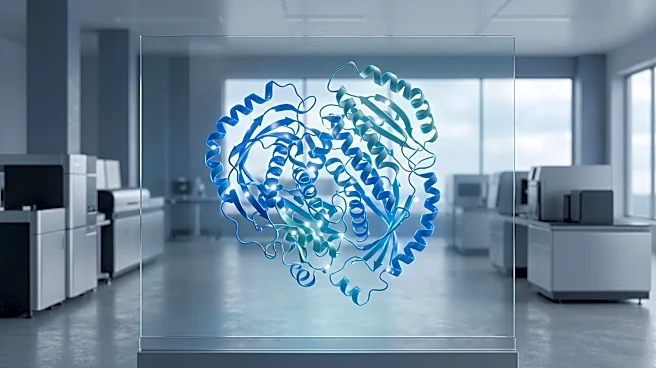
Recent advancements in protein language models, particularly those trained on antibody sequences, are revolutionizing the design and refinement of therapeutic antibodies. Researchers are leveraging artificial intelligence to predict antibody structures,
generate new antibody candidates, and optimize existing ones with unprecedented efficiency. For instance, DeepAb and IgFold models can predict antibody structures rapidly and accurately, even for complex variable loops. Specialized language models like AbLang, trained specifically on antibody sequences, have proven more effective at restoring missing residues in antibody sequences than general protein language models. Furthermore, generative models like IgLM can create synthetic antibody libraries and redesign specific regions of antibodies, while general protein language models can guide the evolution of human antibodies, improving binding affinities significantly with minimal experimental screening.
Why It's Important?
The development of new and improved therapeutic antibodies is critical for treating a wide range of diseases, including infectious diseases and cancer. Traditionally, antibody discovery and optimization have been time-consuming and resource-intensive processes, often relying on large-scale experimental screening. These AI-driven approaches drastically reduce the need for extensive wet-lab work, making the process faster, cheaper, and more efficient. By predicting structure, generating novel sequences, and guiding mutations, these models can identify highly effective and developable antibody candidates more quickly. This acceleration in antibody engineering has direct implications for pharmaceutical development, potentially bringing new and more potent treatments to patients faster and at a lower cost, thereby impacting public health and the biopharmaceutical industry.
What's Next?
The future of antibody engineering will likely see a continued integration of AI and machine learning into every stage of the design-build-test-learn cycle. Researchers anticipate that these models will become even more sophisticated, capable of predicting not only structure and binding affinity but also developability issues such as solubility and immunogenicity. The goal is to automate the entire process, where models propose variants, automated assays test them, and the results retrain the models, creating a 'self-driving lab.' This paradigm shift will enable the exploration of vast antibody sequence spaces in silico, with wet-lab experiments serving primarily as confirmation steps rather than initial searches. This will lead to a more streamlined and innovative pipeline for therapeutic antibody development, potentially unlocking treatments for previously intractable diseases.
Beyond the Headlines
The application of protein language models to antibody design represents a broader trend in scientific discovery: the increasing reliance on computational methods to understand and manipulate biological systems. This shift from purely experimental biology to a hybrid computational-experimental approach has profound implications for how scientific research is conducted and how new medicines are developed. It highlights the power of 'learning the language of a biomolecule' to read, write, and improve it, largely in silico. This approach could extend beyond antibodies to other biomolecules, fundamentally changing drug discovery and personalized medicine. However, it also raises questions about data dependency, the interpretability of complex AI models, and the potential for bias in the training data to influence outcomes, necessitating careful validation and ethical considerations in the deployment of these powerful tools.