





What's Happening?
Nammo UK has successfully completed a prototype hot-fire test campaign for its RELIANCE engine, which is designed to be the main descent engine for the European Space Agency’s (ESA) Argonaut lunar lander. This milestone validates a new deep-throttling,
electric pump-fed propulsion architecture, aiming to provide Europe with autonomous access to the lunar surface by the end of the decade. The 6-kilonewton (kN) bi-propellant prototype demonstrated stable combustion across a 50 percent to 100 percent throttle range, crucial for precision Moon landings. This engine utilizes a pintle injector and electrically driven centrifugal pumps, allowing for fine flow regulation and lighter propellant tank pressures. The RELIANCE engine builds on the flight heritage of Nammo UK’s LEROS thruster family, which includes engines used in NASA’s Juno spacecraft and Firefly Aerospace’s Blue Ghost lunar landing. Robert Selby, vice president of Nammo Space, highlighted this as a significant development for both the program and European lunar exploration.
Why It's Important?
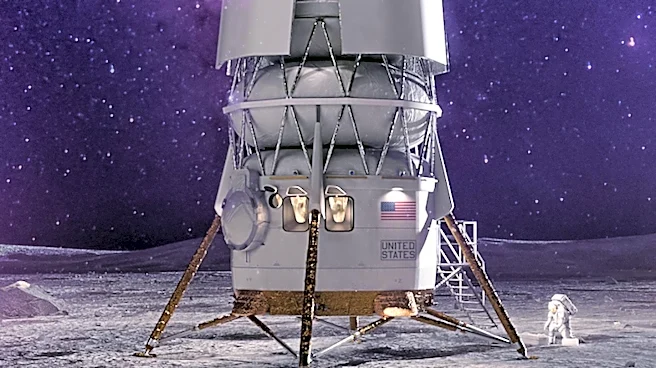
The successful testing of the RELIANCE engine is a critical step for Europe's space capabilities, enabling it to independently deliver heavy cargo to the Moon. This development directly supports NASA’s Artemis campaign, as the Argonaut lander is designed to deliver up to 3,300 pounds (1,500 kilograms) of cargo, scientific instruments, power systems, and communications infrastructure to the Moon, particularly near the lunar south pole. The ability to perform precision landings with continuous thrust adjustments is vital for establishing a sustained human presence on the Moon, a key objective of the Artemis program. For the U.S., this collaboration with European partners strengthens the overall effort to return humans to the Moon and establish a lunar base, sharing the technological burden and expanding the international coalition in space exploration. The advanced propulsion system could also be adapted for future lunar return missions and deep-space exploration vehicles, indicating broader implications for future space endeavors.
What's Next?
Following the successful prototype campaign and Preliminary Design Review, Nammo UK will proceed with building and testing an Engineering Model of the RELIANCE engine in 2027. This phase is a crucial step towards flight qualification over the next three years. The Argonaut lunar lander, which will utilize three RELIANCE main engines for its Lunar Descent Element, is planned for launch in 2030 on an Ariane 6 rocket. The focus for Nammo UK will now shift towards ensuring the engine meets all flight qualification standards. This will involve rigorous testing and refinement to prepare for its role in guiding Europe's first dedicated lunar lander safely to the Moon. The successful deployment of Argonaut will mark a significant achievement for European space autonomy and its contribution to the broader international lunar exploration efforts, including NASA's Artemis campaign.
Beyond the Headlines
The development of the RELIANCE engine signifies a broader trend towards international collaboration and distributed technological development in space exploration. While the U.S. leads the Artemis program, the reliance on European partners for critical components like advanced propulsion systems highlights the interconnectedness of global space efforts. This collaboration can lead to shared risks, diversified expertise, and accelerated progress in achieving complex space missions. Furthermore, the engine's deep-throttling capability represents a significant technological advancement, offering greater precision and flexibility for lunar landings, which is crucial for future resource utilization and scientific research on the Moon. This could also foster greater competition and innovation within the commercial space sector, as more nations and private entities gain the capability to access and operate on the lunar surface, potentially leading to new economic opportunities and scientific discoveries.