





What's Happening?
A Windracers ULTRA autonomous aircraft, owned by Purdue University, successfully completed a historic beyond visual line of sight (BVLOS) flight within the newly established Indiana Drone Corridor. The milestone flight, covering over 50 miles, took place
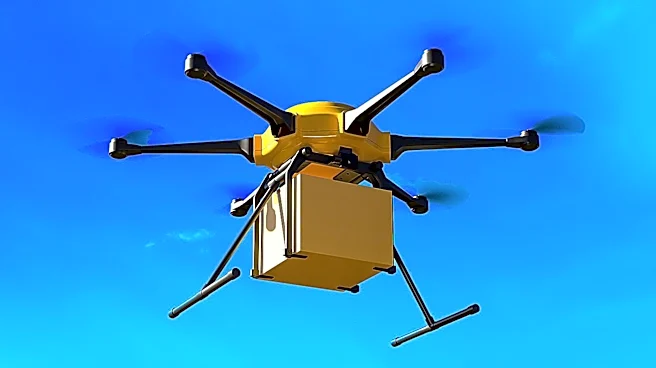
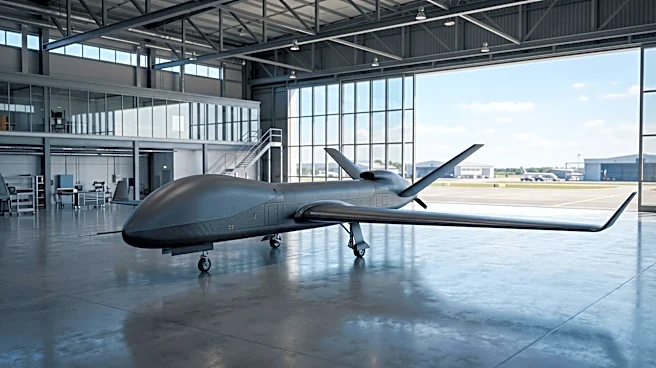
on October 29, 2026, coinciding with a grand opening event at Terre Haute Indiana Airport. Indiana Governor Mike Braun, U.S. Senator Todd Young, and U.S. Representative Mark Messmer attended the ribbon-cutting ceremony, where they witnessed an operational demonstration of autonomous cargo delivery. The ULTRA aircraft, developed by British specialist Windracers, features a 33-foot aluminum airframe and a proprietary flight control system for fully autonomous operations. It is equipped with a versatile three-bay drop-door configuration, which was used to demonstrate precision cargo deployment via an autonomous parachute resupply display during the event.
Why It's Important?
This historic BVLOS flight marks a significant advancement in the integration of unmanned aviation systems into regional transportation infrastructure in the United States. The successful demonstration of autonomous cargo delivery highlights the potential for these heavy-lift drones to revolutionize logistics, particularly for emergency response, humanitarian aid, and remote cargo transport. By enabling long-range BVLOS operations, the technology can unlock unprecedented efficiency for commercial and defense logistics networks, reducing reliance on traditional, often more costly and time-consuming, methods of transport. The involvement of state and federal officials, including Governor Mike Braun, Senator Todd Young, and Representative Mark Messmer, underscores the governmental support and recognition of the strategic importance of developing and deploying advanced drone technology for various applications, potentially creating new economic opportunities and enhancing national capabilities.
What's Next?
The successful deployment of the Windracers ULTRA in the Indiana Drone Corridor is expected to pave the way for further development and expansion of autonomous aviation capabilities. Company representatives emphasize that scaling long-range BVLOS operations is a key objective, suggesting that more widespread adoption of such systems for commercial and defense logistics is on the horizon. This could lead to increased investment in drone technology, infrastructure development, and regulatory frameworks to support broader autonomous flight operations. The demonstrated capabilities for emergency logistics and humanitarian aid also indicate potential future applications in disaster relief efforts and delivering essential supplies to underserved areas. Continued collaboration between academic institutions like Purdue University, private companies, and government entities will be crucial for advancing this technology and integrating it safely and effectively into the national airspace.
Beyond the Headlines
The successful BVLOS flight of the Windracers ULTRA in Indiana signifies a broader shift towards autonomous systems in various sectors, with profound implications for labor markets, infrastructure, and regulatory policy. The increased efficiency in logistics could lead to job displacement in traditional transport sectors but also create new jobs in drone manufacturing, operation, maintenance, and data analysis. Ethically, the deployment of autonomous cargo delivery raises questions about safety protocols, liability in case of accidents, and the potential for misuse of such technology. Legally, existing airspace regulations will need to evolve to accommodate the widespread operation of BVLOS drones, requiring careful consideration of air traffic control, privacy concerns, and national security. Culturally, the increasing presence of autonomous aircraft in the skies could alter public perception of technology and automation, potentially leading to both greater acceptance and new anxieties about the future of work and human control.