





What's Happening?
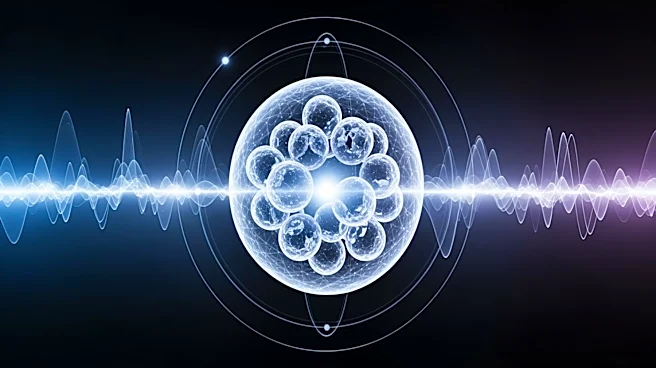
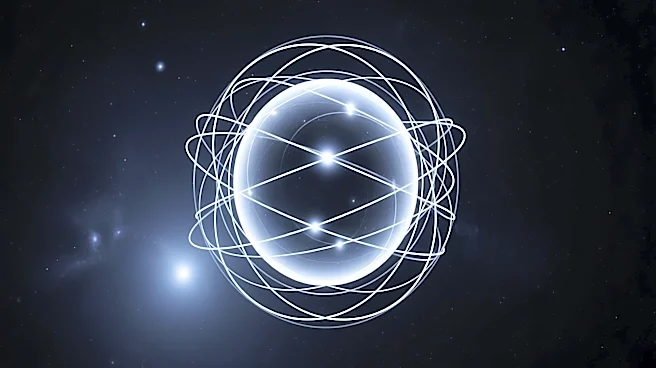
The CMS Collaboration has conducted a study to explore the fundamental nature of quarks, probing them to a scale of 10⁻²⁰ meters. This research aims to determine whether quarks, which are currently considered fundamental particles, have any substructure.
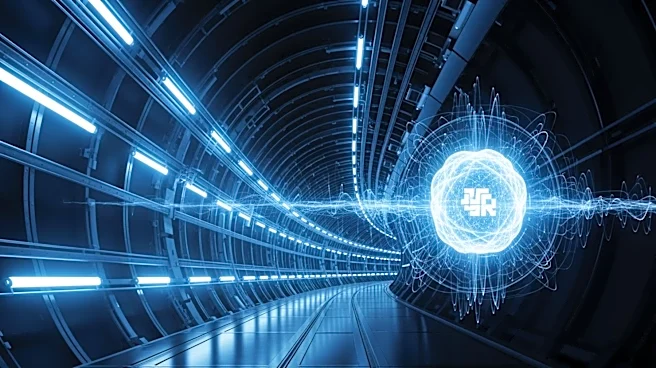
The study involved high-energy collisions of protons at the Large Hadron Collider (LHC), where the resulting quarks were analyzed for any signs of internal structure. The findings showed no evidence of quarks being composed of smaller particles, supporting the current understanding of quarks as point-like entities. This research builds on historical discoveries in particle physics, such as the identification of atoms and their subcomponents, and continues the quest to understand the smallest building blocks of matter.
Why It's Important?
This research is significant as it reinforces the current model of particle physics, which posits quarks as fundamental particles. By confirming the lack of substructure in quarks, the study supports existing theories and provides a more detailed understanding of matter at the smallest scales. The findings have implications for theoretical physics, potentially guiding future research and experiments. The study also highlights the capabilities of the LHC and the CMS Collaboration in pushing the boundaries of particle physics, contributing to the broader scientific effort to uncover the fundamental nature of the universe.
What's Next?
Future research will continue to explore the potential for discovering even smaller structures within quarks. The upcoming High-Luminosity LHC will provide higher energy collisions, which could offer more precise measurements and possibly reveal new insights into the composition of quarks. As technology and experimental techniques advance, scientists will be able to probe deeper into the fundamental nature of matter, potentially leading to groundbreaking discoveries in particle physics.