



What's Happening?
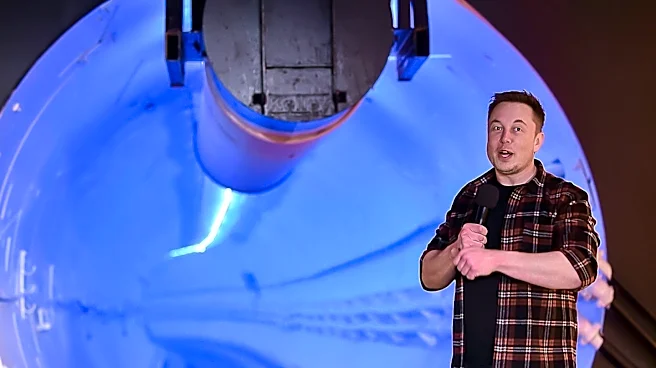
U.S. Representative Wesley Hunt, in collaboration with the Office of the Texas Lieutenant Governor Dan Patrick, has partnered with The Boring Company (TBC) to propose an alternative solution for Harris County's persistent flooding issues in Houston. This
initiative suggests a $760 million project involving two parallel 12-foot-diameter tunnels, each stretching 36 miles. These tunnels are designed to divert stormwater directly to the Gulf of Mexico. This proposal stands in contrast to traditional flood-control plans for Houston, which typically involve constructing much larger, 30- to 40-foot-diameter deep tunnels, with a single segment along Buffalo Bayou estimated to cost $4.6 billion. The Harris County Commissioners Court has unanimously voted to study a pilot program based on TBC's specifications, indicating a serious consideration of this innovative approach to infrastructure.
Why It's Important?
This partnership and proposed project are significant for several reasons. Firstly, it represents a potential shift in how major infrastructure challenges, such as urban flooding, are addressed in the U.S., particularly in rapidly growing areas like Houston. The use of The Boring Company's tunneling technology, which aims for lower costs and faster deployment compared to traditional methods, could set a precedent for future public works projects. If successful, this model could offer a more economically viable and efficient way to tackle complex environmental and urban development issues. Secondly, the involvement of a U.S. Representative and the Office of the Texas Lieutenant Governor highlights a growing interest in leveraging private sector innovation for public infrastructure, potentially fostering more public-private partnerships. This approach could also influence policy-making regarding infrastructure funding and regulatory processes, potentially streamlining project approvals for similar initiatives nationwide.
What's Next?
The immediate next step is the study of a pilot program based on The Boring Company's proposed specifications, as unanimously approved by the Harris County Commissioners Court. This study will likely evaluate the feasibility, cost-effectiveness, and environmental impact of the smaller, parallel tunnel system compared to traditional large-scale tunneling projects. Depending on the findings of this pilot program, a decision will be made regarding the full-scale implementation of the $760 million project. Success in Houston could lead to the adoption of similar tunneling solutions in other U.S. cities facing comparable infrastructure challenges, particularly those related to stormwater management and flood control. This project could also serve as a case study for how federal and state entities can collaborate with private technology companies to address critical infrastructure needs.
Beyond the Headlines
Beyond the immediate goal of flood control, this project touches upon broader implications for U.S. infrastructure development. The Boring Company's approach, which emphasizes reducing tunneling costs and accelerating construction timelines through technological innovation, could disrupt the traditional civil engineering industry. If proven effective and scalable, this could lead to a re-evaluation of how large-scale underground infrastructure, including utilities and transportation, is planned and executed across the nation. Furthermore, the focus on a 'Property-Rights-First Model' that aims to avoid eminent domain takings by utilizing existing rights-of-way, as mentioned in the broader context of Texas infrastructure, could address long-standing legal and social challenges associated with infrastructure expansion. This initiative could also spur further investment in advanced tunneling technologies and encourage more innovative solutions for urban resilience and sustainability.