





What's Happening?
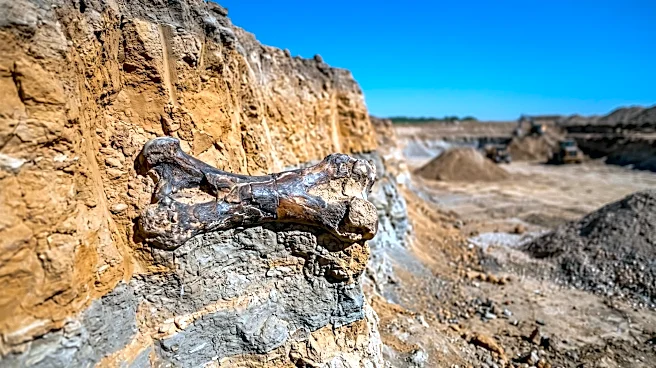
Construction crews in Oceanside, California, working on a city water department project, have unearthed fossilized remains believed to belong to a 'thunder beast,' a large, hoofed mammal that lived approximately 45 million years ago. Contract paleontologist
Joseph El Adli made the discovery within minutes of arriving at the site, noticing something protruding from a 15-foot-deep excavation wall. The largest bone found is a femur, measuring 2.5 to 3 feet long, which narrows the possibilities to either a brontothere (thunder beast) or an amynodont (swamp rhinoceros). Both were plant-eaters, and El Adli suggests it is likely a brontothere due to its higher prevalence in the region during the Eocene Epoch. Most of the fossils are pieces of limbs and ribs, currently encased in mudstone blocks for further examination. These fossils are not actual bones but minerals that have replaced the original bone material over millions of years, turning them to rock. The discovery occurred in the Santiago formation, a sedimentary rock layer common in northwestern San Diego County, indicating the area was once a green, tropical jungle.
Why It's Important?
This discovery is significant for understanding the prehistoric ecology of Southern California, particularly the Eocene Epoch, when the region was a tropical jungle. The identification of a 'thunder beast' or 'swamp rhinoceros' provides valuable insights into the types of large mammals that inhabited North America millions of years ago, predating the Ice Age and long after the dinosaurs. Such finds contribute to the broader scientific understanding of evolutionary history and ancient climates. For the local community, it highlights the rich paleontological heritage of San Diego County, where fossil discoveries are relatively common. The careful excavation and study of these fossils will enrich museum collections and provide educational opportunities, allowing researchers and the public to connect with the deep past of the region. It also underscores the importance of archaeological monitoring in construction projects, as mandated by California's Environmental Quality Act, ensuring that significant historical and scientific resources are preserved.
What's Next?
The unearthed fossils, primarily pieces of limbs and ribs, are currently encased in mudstone blocks and will be transported to Joseph El Adli's workplace for detailed examination. Over the coming weeks, these blocks will be carefully opened, and the fossils will be studied more closely. El Adli will be looking for signs of gnawing by carnivores, which could provide clues about the animal's death and preservation. A key objective is to locate a skull, which would definitively confirm the species. There is a possibility that a skull could be present within the plaster-wrapped blocks already removed from the site. Once El Adli's work is complete and the fossils are prepared for long-term storage, they are expected to be transferred to institutions such as the San Diego Natural History Museum or another museum for permanent preservation and further scientific study. Oceanside city officials have withheld the exact location of the discovery to ensure the safety and integrity of the site.
Beyond the Headlines
The discovery of these ancient fossils in Oceanside transcends a mere scientific find; it offers a profound glimpse into the deep geological and biological history of the region, reminding residents that the land beneath their feet has undergone dramatic transformations over millions of years. The Eocene Epoch, characterized by a tropical, steamy environment, stands in stark contrast to present-day Southern California, prompting reflection on climate change and ecological shifts over vast timescales. The fact that these fossils are not actual bones but mineral replacements highlights the intricate processes of fossilization and the immense time scales involved in geological preservation. This find also underscores the critical role of environmental regulations, such as California's Environmental Quality Act, in safeguarding invaluable paleontological and archaeological resources during urban development. It fosters a deeper appreciation for the unseen history embedded in the landscape and encourages a sense of stewardship for these ancient treasures, which offer unique windows into Earth's past ecosystems.