





What's Happening?
NASA has awarded SpaceX three additional crew rotation missions to the International Space Station (ISS) through a modification to its Commercial Crew Transportation Capability (CCtCap) contract. This contract modification adds Crew-15, Crew-16, and Crew-17
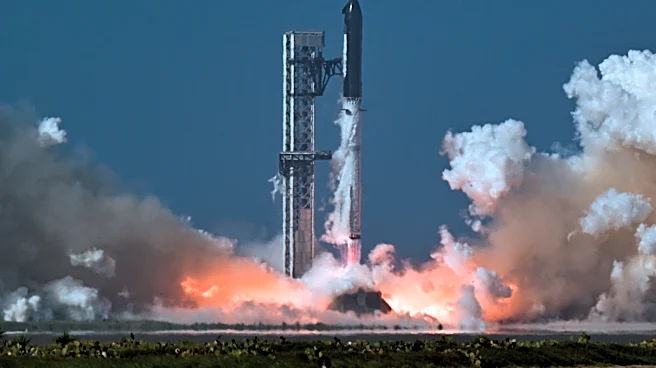
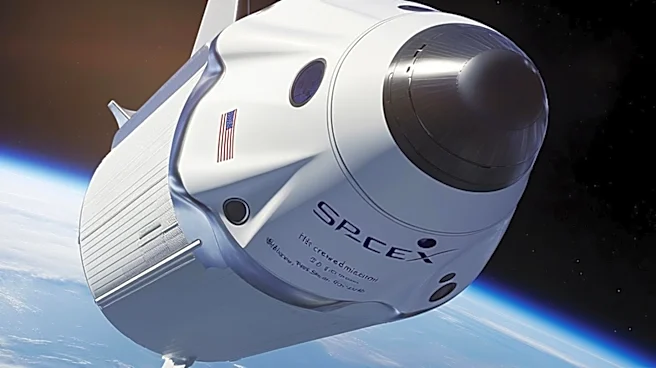
to SpaceX's manifest, bringing the total number of missions for the company to 17. The value of this modification, covering all three missions and associated services, is $946 million. These services include ground operations, launch, in-orbit support, return and recovery operations, cargo transportation, and a lifeboat capability while docked at the ISS. The period of performance for these missions extends through 2030, with mission readiness dates scheduled for 2027 and 2028. This decision follows a notice of intent issued by NASA in May to purchase these additional missions, aiming to ensure continuous U.S. access to the space station with multiple commercial partners. SpaceX was certified by NASA for crew transportation in November 2020, and its Dragon spacecraft and Falcon 9 rocket are designed to transport up to four astronauts and critical cargo to the ISS.
Why It's Important?
This contract award is crucial for maintaining consistent U.S. access to the International Space Station, ensuring that NASA has reliable transportation for its astronauts and cargo. By utilizing two commercial partners, Boeing and SpaceX, NASA enhances redundancy and competition in space transportation, reducing dependence on any single provider. This strategy is vital for the long-term operational stability of the ISS, which serves as a critical platform for scientific research and technological development. The substantial investment of $946 million underscores the U.S. commitment to commercial spaceflight and its role in future space exploration. For SpaceX, this award solidifies its position as a leading commercial space provider, demonstrating continued confidence in its Dragon spacecraft and Falcon 9 rocket capabilities. The contract also supports the broader U.S. aerospace industry by fostering innovation and creating high-tech jobs, contributing to economic growth and technological advancement.
What's Next?
The newly awarded missions, Crew-15, Crew-16, and Crew-17, are scheduled for readiness in 2027 and 2028, extending SpaceX's role in ISS crew transportation through 2030. NASA will continue to monitor the progress of both SpaceX and Boeing under the CCtCap contracts to ensure mission readiness and safety standards are met. While this modification secures additional flights with SpaceX, NASA has indicated that it may pursue further contract modifications for transportation services as needed, suggesting ongoing opportunities for commercial space companies. The agency will also continue to focus on the development of next-generation spacecraft and launch systems to support future human space exploration beyond low-Earth orbit, including missions to the Moon and Mars. The success of these commercial crew missions will inform future public-private partnerships and the evolution of U.S. space policy.
Beyond the Headlines
This contract extension highlights a significant shift in space exploration, moving from government-led development to a model that heavily relies on commercial partnerships. This approach not only reduces costs for NASA but also stimulates innovation within the private sector, fostering a more dynamic and competitive space industry. The continued reliance on commercial providers like SpaceX for routine access to the ISS frees up NASA's resources to focus on more ambitious deep-space missions, such as the Artemis program. Furthermore, the development of reliable commercial crew transportation capabilities has broader implications for space tourism and private space stations, potentially opening up new economic frontiers in space. The success of these partnerships is critical for maintaining U.S. leadership in space and ensuring the long-term viability of human presence in orbit.