





What's Happening?
The governments of South Sudan and Uganda have signed a Memorandum of Understanding (MOU) aimed at strengthening cross-border cooperation in preventing and responding to disease outbreaks and other public health emergencies. The agreement was signed in Juba
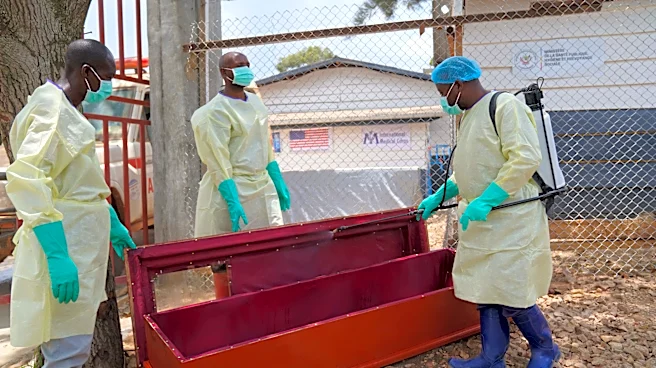
by the health ministers of both countries. This MOU establishes a formal framework for joint surveillance, information sharing, and coordinated preparedness and response efforts to health emergencies along their shared border. South Sudan’s Health Minister, Luke Thompson Thoan Teny, stated that this agreement moves health cooperation between the two nations from general goodwill to an institutionalized system for rapid joint action. Under the MOU, both countries will enhance real-time epidemiological information sharing, mutual notification of outbreaks, joint contact tracing, and coordinated disease surveillance. The agreement also covers cooperation in areas such as biospecimen transfer, harmonized screening at points of entry, and the deployment of coordinated mobile health teams during emergencies.
Why It's Important?
This MOU is crucial for enhancing public health security in the East African region. Cross-border disease outbreaks pose significant challenges, as pathogens can spread rapidly across national boundaries, making containment difficult without coordinated efforts. By institutionalizing cooperation, South Sudan and Uganda can improve their collective ability to detect, prevent, and respond to health crises more effectively. This proactive approach will help mitigate the impact of epidemics on their populations, economies, and healthcare systems. The agreement's provisions for real-time information sharing, joint surveillance, and coordinated responses are vital for a rapid and efficient public health response. Furthermore, harmonized screening at points of entry and coordinated mobile health teams will strengthen border health management, reducing the risk of disease transmission across the shared border. This collaboration also sets a precedent for regional health cooperation, potentially inspiring similar initiatives among other neighboring countries.
What's Next?
Following the signing of the MOU, South Sudan and Uganda will focus on implementing the established framework. This will involve operationalizing mechanisms for real-time epidemiological information sharing and mutual notification of disease outbreaks. Joint contact tracing and coordinated disease surveillance activities will be initiated and strengthened. Both countries will work towards harmonizing screening procedures at points of entry and preparing for the deployment of coordinated mobile health teams during emergencies. Vice President Hussein Abdelbagi Akol emphasized that the government would support measures to remove administrative barriers that could delay emergency health responses, indicating a commitment to facilitating the agreement's practical application. The success of this MOU will depend on consistent communication, resource allocation, and political will from both nations to ensure its provisions are effectively carried out.
Beyond the Headlines
The signing of this MOU extends beyond immediate public health benefits, touching upon broader aspects of regional stability and development. Effective cross-border health security can foster greater trust and cooperation between neighboring states, potentially leading to enhanced collaboration in other sectors. By demonstrating a shared commitment to public welfare, South Sudan and Uganda can strengthen their diplomatic ties and regional integration efforts. This agreement also highlights the growing recognition that health security is intrinsically linked to national security, as disease outbreaks can destabilize societies, disrupt economies, and strain governance structures. The institutionalization of health cooperation can serve as a model for addressing other transnational challenges, such as environmental issues or security threats. Moreover, by building robust public health infrastructure and response capabilities, both countries can improve overall health outcomes for their citizens, contributing to long-term human capital development and economic productivity.