
What's Happening?
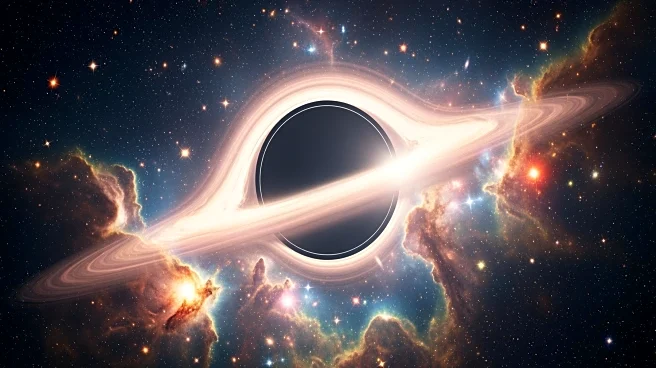
In December 2025, astronomers using the James Webb Space Telescope (JWST) confirmed the observation of a runaway supermassive black hole with a mass of 10 million Suns. This black hole is moving through
space at an extraordinary speed of 2.2 million miles per hour, generating a galaxy-scale shock wave and leaving behind a 200,000 light-year-long tail where new stars are forming. This discovery challenges existing models of black hole and galaxy formation, as the forces required to eject such a massive black hole from its host galaxy are enormous. The observation was described as astonishing by Peter van Dokkum of Yale University, highlighting the significant impact of such events on our understanding of cosmic phenomena.
Why It's Important?
The confirmation of a runaway supermassive black hole has profound implications for astrophysics and our understanding of galaxy evolution. It challenges existing theories about how galaxies and black holes interact and evolve, particularly in the early Universe. The discovery suggests that black holes can be ejected from their host galaxies, which could influence star formation and the distribution of matter in the cosmos. This finding may lead to revisions in models of galaxy formation and the role of black holes in shaping the Universe. Researchers and institutions involved in space exploration and astrophysics stand to gain new insights, potentially leading to further discoveries and advancements in the field.
What's Next?
Future research will likely focus on understanding the mechanisms behind the ejection of supermassive black holes and their impact on galaxy formation. Observatories like JWST and ALMA will continue to play a crucial role in uncovering more about these cosmic phenomena. Scientists may explore the implications of these findings for the history and evolution of galaxies, potentially leading to new models and theories. Collaboration among international research teams and institutions will be essential to further investigate these events and their broader cosmic significance.
Beyond the Headlines
The discovery of a runaway supermassive black hole also raises questions about the ethical and philosophical implications of understanding the Universe's most extreme phenomena. It challenges our perception of cosmic order and the forces governing the Universe. As scientists delve deeper into these mysteries, they may uncover new dimensions of cosmic interactions, prompting discussions about the nature of existence and our place in the cosmos. This could lead to a broader cultural and scientific dialogue about the significance of such discoveries.