






What's Happening?
Representative Jake Auchincloss, a Democratic Congressman from Massachusetts, is advocating for a ballot question that would establish all-party primaries in the state. This proposed system would allow candidates from all political parties to compete
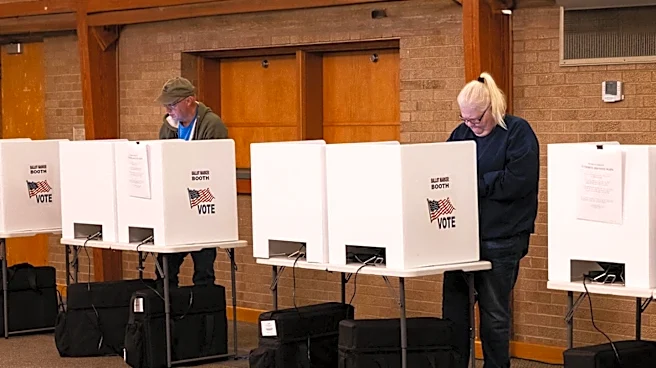
in a single primary election, with the top two vote-getters, regardless of party affiliation, advancing to the general election. Auchincloss's stance places him in agreement with fellow Representative Seth Moulton, but in opposition to Senator Ed Markey, who is against such a system. The initiative, known as Question 3, aims to replace the current partisan primary system for state elections. Proponents argue it could increase competition and voter engagement, particularly in races where the primary effectively decides the outcome due to a lack of general election opposition. The campaign for Question 3 has garnered significant financial backing, raising over $5.1 million since 2025, primarily from large-dollar donors.
Why It's Important?
The debate over all-party primaries in Massachusetts highlights a significant ideological split within the Democratic Party and could have profound implications for the state's political landscape. If adopted, this system could fundamentally alter how candidates are nominated and how elections are contested, potentially leading to more moderate candidates or, conversely, to a greater emphasis on individual candidate appeal over party loyalty. The current system often results in many legislative races being effectively decided in the primary, with nearly three-quarters of races having only one candidate listed on the general election ballot after the primary. An all-party primary could introduce more competitive general elections, forcing candidates to appeal to a broader electorate rather than just their party base. This shift could empower independent voters and those who feel disenfranchised by the current partisan structure, while potentially weakening the influence of established party machines and special interest groups that thrive on closed primary systems.
What's Next?
The proposal for all-party primaries will be presented to Massachusetts voters as Question 3 on the November ballot. The outcome of this vote will determine whether the state transitions from its current partisan primary system to an all-party primary model. The campaign for and against Question 3 is expected to intensify, with significant financial resources already being deployed by proponents. Opponents, including both the state Republican and Democratic parties, as well as some progressive activists and labor unions, are actively campaigning against the measure. Their arguments often center on concerns that the system might not solve underlying democratic problems and could be influenced by wealthy donors. The results of the vote will not only reshape Massachusetts elections but could also serve as a precedent or a case study for other states considering similar electoral reforms.
Beyond the Headlines
The discussion around all-party primaries extends beyond mere procedural changes; it touches upon fundamental questions of democratic representation and the role of political parties. Critics argue that such systems, while seemingly promoting broader participation, can be influenced by well-funded interests seeking to 'tilt the political landscape.' Senator Elizabeth Warren, for instance, has previously opposed similar ballot questions, citing concerns about billionaire funding. This raises ethical questions about the influence of money in politics and whether electoral reforms genuinely serve the public interest or the agendas of powerful donors. Furthermore, the shift could lead to a decline in party cohesion and discipline, as candidates might prioritize individual appeal over party platforms. The long-term impact on voter turnout, candidate diversity, and the overall health of democratic institutions in Massachusetts will be closely watched, offering valuable insights into the evolving nature of American electoral processes.