






What's Happening?
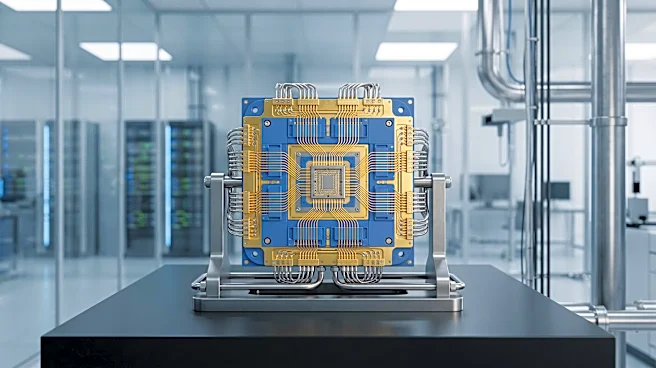
Federal agencies in the U.S. are significantly increasing their investments and validation efforts in quantum computing, signaling a critical phase for the technology. The Special Competitive Studies Project (SCSP) released a preliminary report from the Commission
on U.S. Quantum Primacy, acknowledging the transformative potential of quantum computing in fields like chemistry, materials science, and drug discovery, despite current technical constraints. Deputy Secretary of Commerce Paul Dabbar announced a $2 billion investment with nine companies to accelerate U.S. leadership in quantum computing and committed the Commerce Department to be an early adopter of post-quantum cryptography. Concurrently, the Defense Advanced Research Projects Agency (DARPA) is entering the final stage of its Quantum Benchmarking Initiative, aiming to determine the feasibility of developing an 'industrially useful' quantum computer by 2033. This third phase involves companies working with DARPA to verify and validate the design and operation of utility-scale quantum computer concepts. Whitney Mason, director for the Multi X Office at DARPA, emphasized the initiative's goal to assess the true potential of quantum hardware and error correction capabilities.
Why It's Important?
The intensified focus by U.S. federal agencies on validating quantum computing's real-world utility marks a pivotal moment for the technology's integration into national infrastructure and industry. The substantial investment from the Commerce Department underscores a strategic commitment to securing U.S. leadership in this emerging field, which could unlock new markets and solve complex problems in energy, rail, and security. The push for post-quantum cryptography adoption by the Commerce Department highlights a proactive approach to safeguarding national security and critical systems against future quantum threats to current encryption standards. DARPA's rigorous benchmarking initiative is crucial for transitioning quantum computing from theoretical research to practical applications, providing a standardized metric to evaluate diverse quantum technologies. This will help policymakers and investors identify the most promising technologies, ensuring that significant resources are directed towards solutions that offer tangible economic and societal value. The emphasis on preventing intellectual property theft also reflects a broader concern for maintaining U.S. technological advantage against foreign competitors.
What's Next?
DARPA's Quantum Benchmarking Initiative will proceed with initial engagements for its third and final phase in January, where participating companies, including IonQ, will work to verify and validate their quantum computer concepts. This phase is designed to establish 'no-go' conditions that must be met by 2033 to prove the technology's viability and demonstrate quantifiable value. The Commerce Department plans to invite companies to a post-quantum cryptography demonstration next month, aiming to be the first major customer for this technology within the federal government. These efforts will provide critical data for policymakers and industry stakeholders to make informed decisions regarding future investments and strategic directions in quantum computing. The outcomes of these validation processes will determine which quantum technologies are genuinely poised for near-term deployment and will influence the allocation of resources for further research and development. The ongoing focus on intellectual property protection suggests continued vigilance against foreign espionage and efforts to secure U.S. quantum advancements.
Beyond the Headlines
The U.S. government's aggressive push into quantum computing and post-quantum cryptography carries significant ethical and legal implications, particularly concerning data security and national sovereignty. As quantum computers advance, they pose a potential threat to existing internet security protocols, necessitating the rapid development and adoption of quantum-resistant cryptography. This creates a 'quantum race' where the first to achieve fault-tolerant quantum computing could gain a substantial strategic advantage in intelligence, defense, and economic sectors. The emphasis on protecting U.S. quantum advances from foreign competitors, as highlighted by officials like Deputy Secretary of Commerce Paul Dabbar and FBI Section Chief Michael Massetti, underscores the geopolitical stakes involved. The potential for quantum technology to disrupt global power dynamics and create new forms of cyber warfare or espionage is a profound concern. Furthermore, the ethical considerations surrounding the immense computational power of quantum computers, such as their potential misuse for surveillance or the development of advanced weaponry, will require careful consideration and international cooperation to establish responsible governance frameworks.