
What's Happening?
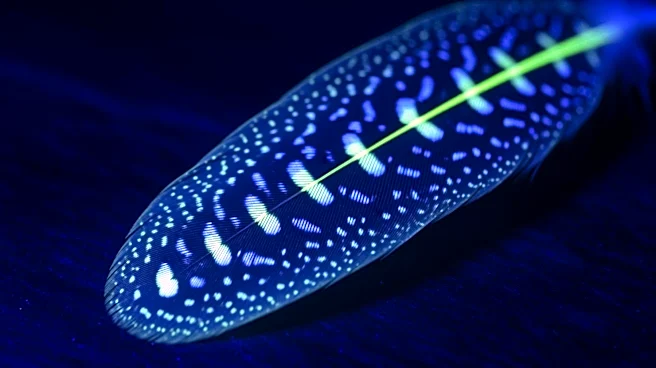
A recent discovery has revealed that the southern cassowary, a large flightless bird native to Australia and New Guinea, exhibits a unique fluorescence under ultraviolet (UV) light. This finding was made
by Todd Green, an anatomist and paleontologist, during a visit to the Cassowary Conservation Project in Florida. Using an ultraviolet flashlight, Green observed that the keratin in the cassowary's horn-like structure on its head emitted a bright fluorescence, a phenomenon not previously documented in these birds. The discovery was made with a cassowary named Ginger, known for her calm temperament, which allowed for such experiments. This fluorescence is visible to many birds but not to humans, adding a new dimension to the understanding of avian biology.
Why It's Important?
The discovery of fluorescence in cassowaries under UV light is significant as it opens new avenues for research into avian biology and the evolutionary adaptations of birds. This phenomenon could have implications for understanding how birds perceive their environment and communicate. The ability to fluoresce might play a role in mating rituals, predator avoidance, or other ecological interactions. Additionally, this finding contributes to the broader field of biofluorescence, which is increasingly recognized as a widespread trait among various animal species. Understanding these biological traits can provide insights into the evolutionary pressures that shaped them and their ecological significance.